Margins




548 Market St PMB 65688, San Francisco California 94104-5401 USA
© 2026 Paratext Inc. All rights reserved
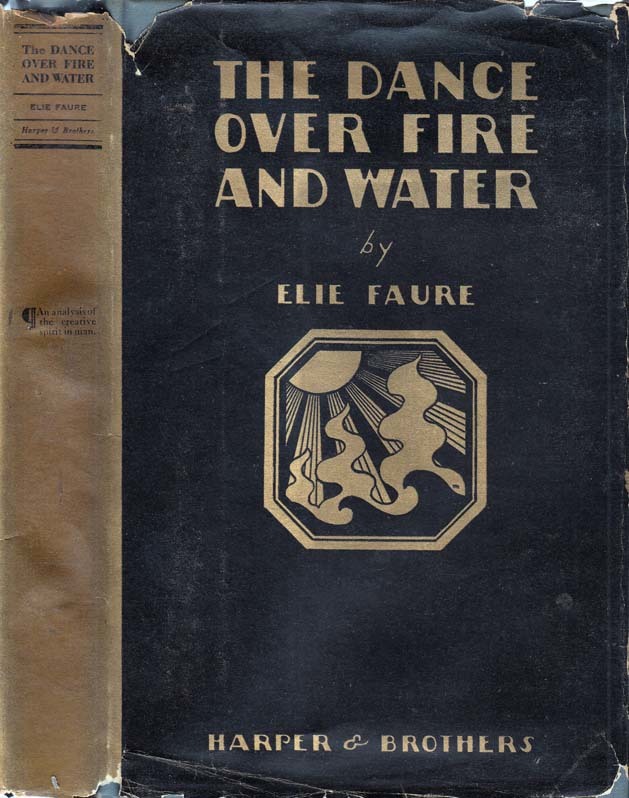
A volume in which Faure surveys the vast field of human life. How man has progressed and retrogressed; what part war has played in his growth; the meaning of his arts, philosophies and religions" Preparatory.—Of civilization.—Tragedy, mother of the arts.—On the immortality of the just man.—The Holy Spirit.—The morality of art.—Cleon on Parnassus.—The eye of the master.—A plea for three criminals. “There is no history for a people, as there is no personality for a man, unless he consents to inflict upon the stone, the sound, the word, or the bold adventurous action, the form of that lyric reality which he discovers in the universe.” –Elie Faure, The Dance Over Fire And Water, pg. 1 “I believe that it is necessary simply to learn to play with the most frightful realities of this world, which are also the most permanent. From the time that we know them to be indispensable, from the time that we have gone one step further than they, from the time that we discover at our own expense that the feelings of clear sighted horror that they awaken in our souls cause to flow back into it, like a revenge of the reason liberated from its chains, and of life set free from its limitations, the lyric indifference of great contemplation, one tastes an unspoiled and intoxicating delight. The abyss is covered in flowers.” –Elie Faure, The Dance Over Fire And Water, pg. 5. “Art is identical with love, which is, in each of us, a need existing before the meeting with the man or woman with whom it becomes identified for a day, a month, or a year, and which survives this meeting to wander, unsatisfied and miserable, up to the hour that the meeting with another woman or man excites its resurrection.”— Elie Faure, The Dance Over Fire And Water, pg. 83 “Now, when the social organism is in fragments, when criticism has taken up everything in order to destroy and refound everything, a hero appears—as I have already said, it seems—who will sustain the temple on his shoulder and gather up in the silence of his generous and despairing heart the love which has abandoned the multitudes.”— Elie Faure, The Dance Over Fire And Water, pg. 119 Editorial comment: "just above Ulysses as the book that had the most pronounced impact on me."