Margins




548 Market St PMB 65688, San Francisco California 94104-5401 USA
© 2026 Paratext Inc. All rights reserved
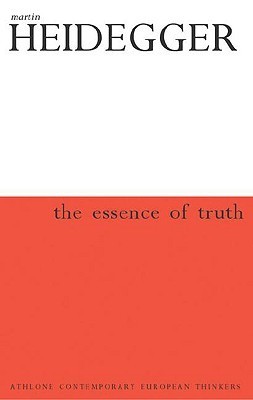
The Essence of Truth must count as one of Heidegger's most important works, for nowhere else does he give a comparably thorough explanation of what is arguably the most fundamental and abiding theme of his entire philosophy, namely the difference between truth as the "unhiddenness of beings" and truth as the "correctness of propositions". For Heidegger, it is by neglecting the former primordial concept of truth in favor of the latter derivative concept that Western philosophy, beginning already with Plato, took off on its "metaphysical" course towards the bankruptcy of the present day. This first ever translation into English consists of a lecture course delivered by Heidegger at the University of Freiburg in 1931-32. Part One of the course provides a detailed analysis of Plato's allegory of the cave in the Republic, while Part Two gives a detailed exegesis and interpretation of a central section of Plato's Theaetetus, and is essential for the full understanding of his later well-known essay Plato's Doctrine of Truth. As always with Heidegger's writings on the Greeks, the point of his interpretative method is to bring to light the original meaning of philosophical concepts, especially to free up these concepts to their intrinsic power. The Essence of Truth must count as one of Heidegger's most important works, for nowhere else does he give a comparably thorough explanation of what is arguably the most fundamental and abiding theme of his entire philosophy, namely the difference between truth as the "unhiddenness of beings" and truth as the "correctness of propositions". For Heidegger, it is by neglecting the former primordial concept of truth in favor of the latter derivative concept that Western philosophy, beginning already with Plato, took off on its "metaphysical" course towards the bankruptcy of the present day. This first ever translation into English consists of a lecture course delivered by Heidegger at the University of Freiburg in 1931-32. Part One of the course provides a detailed analysis of Plato's allegory of the cave in the Republic, while Part Two gives a detailed exegesis and interpretation of a central section of Plato's Theaetetus, and is essential for the full understanding of his later well-known essay Plato's Doctrine of Truth. As always with Heidegger's writings on the Greeks, the point of his interpretative method is to bring to light the original meaning of philosophical concepts, especially to free up these concepts to their intrinsic power.