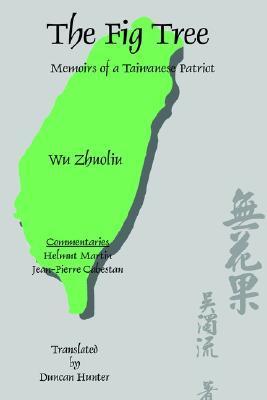
Pioneering writer on the complexity and ambiguity of the Taiwanese identity, humanist and moderate Wu Zhuoliu (1900-1976), a Taiwanese Hakka, looks back over his life from the perspective of the 28 February 1947 massacres, describing his rural childhood in the Japanese colony of Taiwan, his growing political consciousness as a teacher in the island's Japanese school system and his traumatic realization, after a war-time visit to China, that the idealized 'motherland' was no more his home than Japan was. An indictment of the colonial experience and of Chiang Kai-shek's repressive Nationalist government in pre-democratic Taiwan, The Fig Tree chronicles Wu's, almost reluctant, espousal of a separate Taiwanese identity. Valuable additions to this translation by Duncan Hunter are commentaries by Jean-Pierre Cabestan, Director of the Hong Kong-based French Centre for Research on Contemporary China - How open-ended is Taiwan's future? - and the late Helmut Martin, formerly Professor of Chinese Language and Literature at the Ruhr University, Bochum, Germany -Wu Zhuoliu's autobiographies: Acts of resistance against repression and oblivion. These, together with the text itself, the chapter notes and international bibliography, make The Fig Tree essential reading for all students of Taiwan, issues of culture and identity, and of China/Taiwan relations.