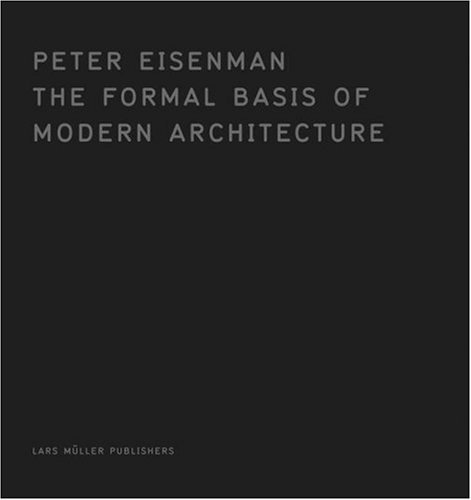
The Formal Basis of Modern Architecture
2006
First Published
4.07
Average Rating
456
Number of Pages
In 1963 at the University of Cambridge, Peter Eisenman ― world famous for his Holocaust Memorial in Berlin (2005) and respected and feared by his colleagues for his intellectual acuity and quick-wittedness ― wrote a dissertation on the formal basis of modern architecture. In it, the architect confronts historicism with theory and the analysis of form, whose distinguishing features he regards as the foundation of architectural composition. Eisenman illustrates his observations with numerous, extremely precise hand drawings. This striking document, with its idiosyncratic photographs, fully deserves to be published here, for the first time, in a faithful reproduction of the original. In an afterword, Peter Eisenman discusses this remarkable starting point of his practical and theoretical work.

Avg Rating
4.07
Number of Ratings
41
5 STARS
44%
4 STARS
27%
3 STARS
22%
2 STARS
7%
1 STARS
0%
goodreads
Author

Peter Eisenman
Author · 12 books
Peter Eisenman is an American architect. Eisenman's professional work is often referred to as formalist, deconstructive, late avant-garde, late or high modernist, etc. A certain fragmenting of forms visible in some of Eisenman's projects has been identified as characteristic of an eclectic group of architects that were (self-)labeled as deconstructivists, and who were featured in an exhibition by the same name at the Museum of Modern Art. The heading also refers to the storied relationship and collaborations between Peter Eisenman and post-structuralist thinker Jacques Derrida.