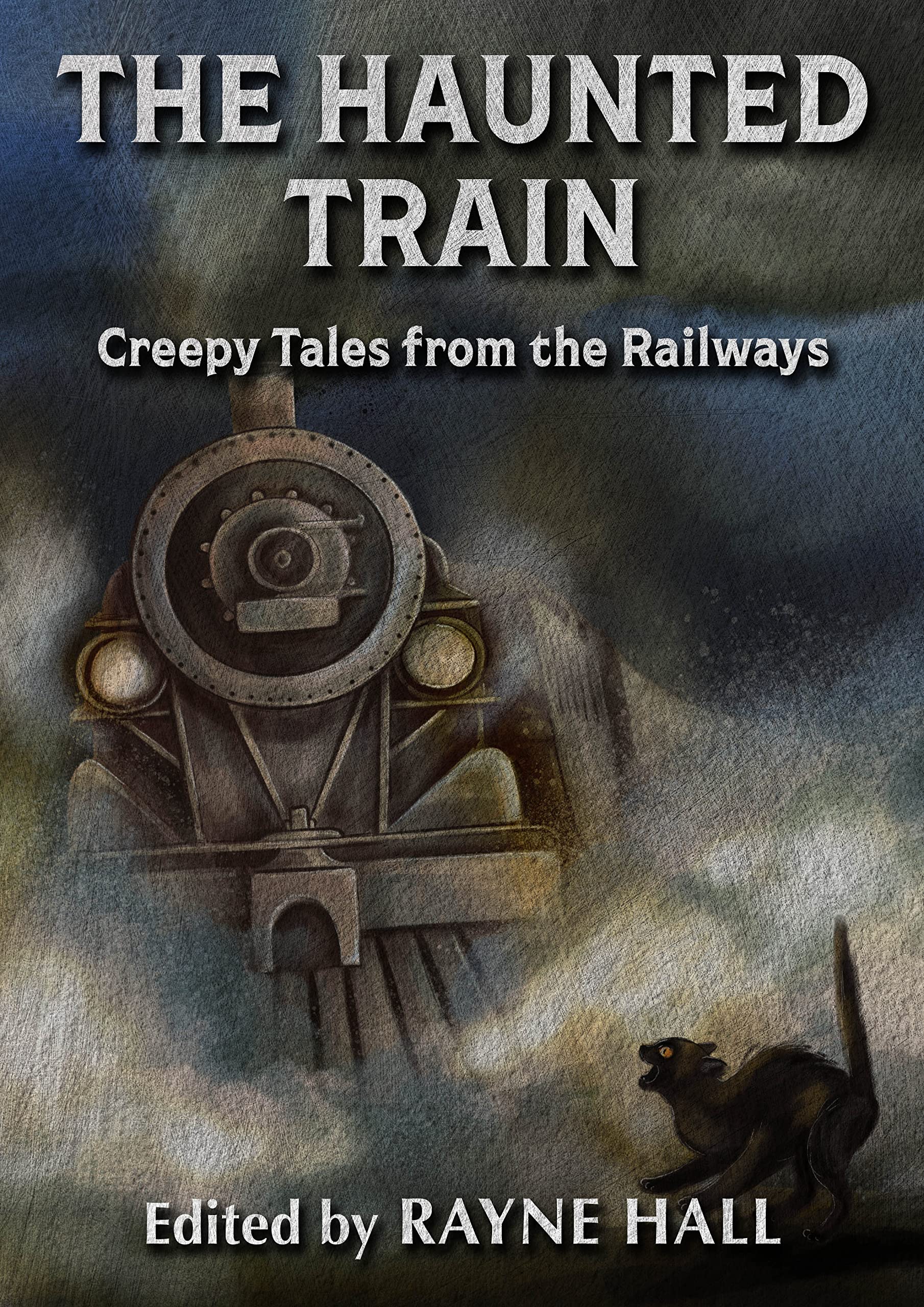



Come on board for a Gothic journey in a funicular railway in Victorian England, a freight train in the Carpathian mountains, a high tech sky train in Bangkok, an underground railway in Tokyo. Visit stations which lure with the promise of safe shelter but harbour unexpected dangers. Meet the people who work on the tracks – stationmasters, porters, signal-men – and those who travel – commuters, tourists, dead bodies, murderers and ghosts. In this volume, editor Rayne Hall has collected twenty of the finest– and creepiest – railway tales. The book features the works of established writers, classic authors and fresh voices. Some stories are spooky, some downright scary, while others pose a puzzling mystery. Some writers use American English, others British. At the end of their tales, they reveal the sources of their inspiration. Are you prepared to come on board this train? Already, the steam engine is huffing in impatience. Listen to the chuff-chuff-chuff from the locomotive and tarattata-tarattata of the giant wheels. Press your face against the dust-streaked window, inhale the smells of coal smoke and old textiles, watch the landscape whoosh past as you leave the familiar behind and journey into the unknown. But be you can’t know the train’s real destination, nor your fellow travellers’ intentions. Once you’ve closed that door behind you and the wheels start rolling, you may not be able to get out. Frederick Beware of Tuesdays. Will the railway ghost still show herself? Clint The Drowned Subway. A commuter in Tokyo travels on a subway train filled with unusual passengers. JD Lost in the Fog. After taking the wrong train, I must spend a cold foggy night in remote railway station. Nicole Why are Trains Always Late? A late-night trip, a woman alone. Edith The Journey. Will this journey take her to the freedom she craves? Morgan A. 11th Hour Ghost Train to Siam. When midnight approaches, a special kind of Bangkokians ride the Skytrain. Rayne Funicular Fare. In Edwardian England, a werewolf takes the funicular railway. Andrew M Wolf Station.. A train engineer makes an unscheduled stop in the Carpathian mountains. Petina Gallows Curve. A notorious accident blackspot has one last life to claim.. Amelia The 4.15 Express. Was it really John Dwerrihouse who travelled with me on that train? Pia Bon Appetit. A pledge candidate will do anything to join an elite fraternity. Zoe Better Late than Never. Can you keep a promise after you die? RJ The Coffin Express. A young man in Victorian London takes a new job with a railway company…one that carries the dead. Krystal Unleashed at the Terminal. Confronted with a demonic force, a former stay-at-home digs deep to find the courage she needs. Joseph S Between the Ties. With their fathers away at war, two boys come across an abandoned railcar that simply shouldn’t exist. Arthur Conan The Man with the Watches. Three passengers have disappeared, and a dead body is found. How could the vanished travellers leave the moving train, and how did the murdered man get on? Cage Blood Lake Train. A man, a memory, a sentient train – and blood spills on the tracks. Michele Seven Stations in Tokyo. Two people living in Tokyo choose the same day to face their ghosts; one is haunted by her past, the other, by his future. Karen Out of Order. A girl stuck in a train toilet fears what may be lurking on the other side of the door. When the lights go out, and the screaming start. Charles The Signal-Man. Whenever the signal-man receives a warning from the spectre, a terrible accident unfolds – and he is unable to prevent it.
Authors
Librarian Note: There is more than one author in the Goodreads database with this name. Children's book author.
Rayne Hall writes fantasy and horror fiction, some of it quirky, most of it dark. She is the author of over sixty books in different genres and under different pen names, published by twelve publishers in six countries, translated into several languages. Her short stories have been published in magazines, e-zines and anthologies. After living in Germany, China, Mongolia and Nepal, she has settled in a small Victorian seaside town in southern England. Rayne holds a college degree in publishing management and a masters degree in creative writing. Over three decades, she has worked in the publishing industry as a trainee, investigative journalist, feature writer, magazine editor, production editor, page designer, concept editor for non-fiction book series, anthology editor, editorial consultant and more. Outside publishing, she worked as a museum guide, apple picker, tarot reader, adult education teacher, trade fair hostess, translator and belly dancer. Currently, Rayne Hall writes fantasy and horror fiction and tries to regain the rights to her out-of-print books so she can republish them as e-books. Her books on the writing craft (Writing Fight Scenes, Writing Scary Scenes, The Word-Loss Diet, Writing Dark Stories, Writing About Villains, Writing Short Stories to Promote Your Novel, Writing About Magic, Twitter for Writers) are bestsellers. Rayne Hall is the editor of the Ten Tales anthologies: "Bites: Ten Tales of Vampires" "Scared: Ten Tales of Horror" "Haunted: Ten Tales of Ghosts" "Cutlass: Ten Tales of Pirates" "Beltane: Ten Tales of Witchcraft" "Spells: Ten Tales of Magic" "Undead: Ten Tales of Zombies" "Seers: Ten Tales of Clairvoyance" "Dragon: Ten Tales of Fiery Beasts" "Cogwheels: Ten Tales of Steampunk" with more titles coming soon. The stories in her Six Scary Tales series and the Thirty Scary Tales collection are subtle horror: suspenseful, creepy atmospheric, unsettling. Although they contain little violence and gore, they may not be suitable for young readers. Many of these stories have been previously published in other books or magazines. British English: All Rayne Hall's books use British words, spellings, grammar and punctuation. If you're allergic to British English, avoid them. ;-) Mailing list: http://eepurl.com/boqJzD Website: http://sites.google.com/site/raynehal... YouTube "Ten Random Facts about Rayne Hall" (2 minute video) https://www.youtube.com/watch?v=sXR4T... Contact Rayne Hall on Twitter @RayneHall follows back writers and readers. http://twitter.com/RayneHall

As a child, Zoe Tasia idolized Barbara Eden, star of I Dream of Jeannie, however, she would have ditched the astronaut and married Captain Kirk. She can’t blink and make magic nor did she wed a Starfleet officer. Instead, life had something better in store for her. She explores her imagination as a writer, is married to an understanding Greek, has two grown sons, and a crazy cat that thinks it’s a dog. Zoe grew up in Oklahoma and lived over seven years in Scotland. Now she resides in the great state of Texas, where everything’s bigger and better, or so she’s told by the natives. When she’s not giving her make-believe friends full rein, she enjoys the opera, ballet, well-chilled champagne and reading, lots and lots of reading. Her first book is Kilts and Catnip (The Shrouded Isle Book 1.) She co-writes books with Minette Lauren under the pen name Zari Reede. Daisy Dukes ‘n Cowboy Boots, a funny romance Blinked, a zany fantasy Sins of the Sister, a psychological thriller

Edith Newbold Jones was born into such wealth and privilege that her family inspired the phrase "keeping up with the Joneses." The youngest of three children, Edith spent her early years touring Europe with her parents and, upon the family's return to the United States, enjoyed a privileged childhood in New York and Newport, Rhode Island. Edith's creativity and talent soon became obvious: By the age of eighteen she had written a novella, (as well as witty reviews of it) and published poetry in the Atlantic Monthly. After a failed engagement, Edith married a wealthy sportsman, Edward Wharton. Despite similar backgrounds and a shared taste for travel, the marriage was not a success. Many of Wharton's novels chronicle unhappy marriages, in which the demands of love and vocation often conflict with the expectations of society. Wharton's first major novel, The House of Mirth, published in 1905, enjoyed considerable literary success. Ethan Frome appeared six years later, solidifying Wharton's reputation as an important novelist. Often in the company of her close friend, Henry James, Wharton mingled with some of the most famous writers and artists of the day, including F. Scott Fitzgerald, André Gide, Sinclair Lewis, Jean Cocteau, and Jack London. In 1913 Edith divorced Edward. She lived mostly in France for the remainder of her life. When World War I broke out, she organized hostels for refugees, worked as a fund-raiser, and wrote for American publications from battlefield frontlines. She was awarded the French Legion of Honor for her courage and distinguished work. The Age of Innocence, a novel about New York in the 1870s, earned Wharton the Pulitzer Prize for fiction in 1921 — the first time the award had been bestowed upon a woman. Wharton traveled throughout Europe to encourage young authors. She also continued to write, lying in her bed every morning, as she had always done, dropping each newly penned page on the floor to be collected and arranged when she was finished. Wharton suffered a stroke and died on August 11, 1937. She is buried in the American Cemetery in Versailles, France.
- Barnesandnoble.com

Charles John Huffam Dickens (1812-1870) was a writer and social critic who created some of the world's best-known fictional characters and is regarded as the greatest novelist of the Victorian era. His works enjoyed unprecedented popularity during his lifetime, and by the twentieth century critics and scholars had recognised him as a literary genius. His novels and short stories enjoy lasting popularity. Dickens left school to work in a factory when his father was incarcerated in a debtors' prison. Despite his lack of formal education, he edited a weekly journal for 20 years, wrote 15 novels, five novellas, hundreds of short stories and non-fiction articles, lectured and performed extensively, was an indefatigable letter writer, and campaigned vigorously for children's rights, education, and other social reforms. Dickens was regarded as the literary colossus of his age. His 1843 novella, A Christmas Carol, remains popular and continues to inspire adaptations in every artistic genre. Oliver Twist and Great Expectations are also frequently adapted, and, like many of his novels, evoke images of early Victorian London. His 1859 novel, A Tale of Two Cities, set in London and Paris, is his best-known work of historical fiction. Dickens' creative genius has been praised by fellow writers—from Leo Tolstoy to George Orwell and G. K. Chesterton—for its realism, comedy, prose style, unique characterisations, and social criticism. On the other hand, Oscar Wilde, Henry James, and Virginia Woolf complained of a lack of psychological depth, loose writing, and a vein of saccharine sentimentalism. The term Dickensian is used to describe something that is reminiscent of Dickens and his writings, such as poor social conditions or comically repulsive characters. On 8 June 1870, Dickens suffered another stroke at his home after a full day's work on Edwin Drood. He never regained consciousness, and the next day he died at Gad's Hill Place. Contrary to his wish to be buried at Rochester Cathedral "in an inexpensive, unostentatious, and strictly private manner," he was laid to rest in the Poets' Corner of Westminster Abbey. A printed epitaph circulated at the time of the funeral reads: "To the Memory of Charles Dickens (England's most popular author) who died at his residence, Higham, near Rochester, Kent, 9 June 1870, aged 58 years. He was a sympathiser with the poor, the suffering, and the oppressed; and by his death, one of England's greatest writers is lost to the world." His last words were: "On the ground", in response to his sister-in-law Georgina's request that he lie down. (from Wikipedia)