Margins
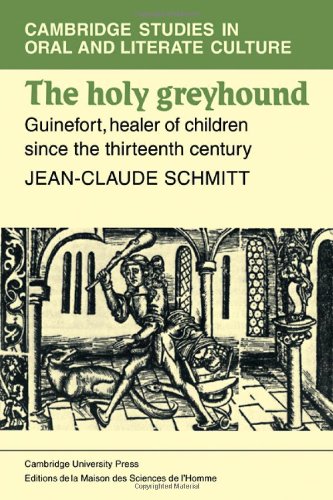
The Holy Greyhound book cover
The Holy Greyhound
Guinefort, Healer of Children since the Thirteenth Century
1979
First Published
3.78
Average Rating
280
Number of Pages
The legend of a dog which is unjustly killed by its master in error, after it has defended his child from attack by a snake or wolf, appears in several popular cultures of Indo-European origin. This book concentrates on one local manifestation of the a cult among the peasants of the Dombes, north of Lyons, who brought their sick child to the grave of 'Saint Guinefort', the martyred greyhound, for preservation from disease. Providing a rare access to the underlying cultural traditions of Europe, all too often submerged in the survivals of literate culture, this book will be welcomed by a wide range of historians and anthropologists.

Avg Rating
3.78
Number of Ratings
102
5 STARS
25%
4 STARS
39%
3 STARS
26%
2 STARS
6%
1 STARS
3%
goodreads

Author

Jean-Claude Schmitt
Jean-Claude Schmitt
Author · 7 books

Jean-Claude Schmitt (born March 4, 1946 in Colmar) is a prominent French medievalist, the former student of Jacques Le Goff. He studies the socio-cultural aspects of medieval history in Western Europe and has made important contributions in his use of anthropological and art historical methods to interpret history. His most significant work has dealt with the relationships among elites and laymen in medieval life, particularly in the realm of religious culture, where he has focused on ideas and topics such as superstition, the occult and heresy in order to flesh out the differing world-views of the lay peasantry and the clerical elites who attempted to define religious practice. He has contributed numerous books, articles and encyclopedia entries on these and related topics. He has also written widely on the cult of saints, the idea of adolescence, visions and dreams, and preaching. Among Schmitt's best known works translated in English are The Holy Greyhound (1983), about the strange cult of a holy dog in medieval France, and Ghosts in the Middle Ages (1998) about notions of death, the afterlife and paranormal visions in medieval culture. Both works are considered important examples of "historical anthropology," or the use of methods and approaches borrowed from anthropology and other social sciences to investigate the past. Schmitt has argued that this has helped correct for the tendency among medievalists in the past to focus on elites, political institutions and narrative history to the exclusion of the lower classes and their less well-documented experiences of life. Schmitt is currently Director of Studies at the École des Hautes Études en Sciences Sociales and directs the society of professional historians, Groupe d'Anthropologie Historique de l'Occident Médiéval.

548 Market St PMB 65688, San Francisco California 94104-5401 USA
© 2026 Paratext Inc. All rights reserved