Margins




548 Market St PMB 65688, San Francisco California 94104-5401 USA
© 2026 Paratext Inc. All rights reserved
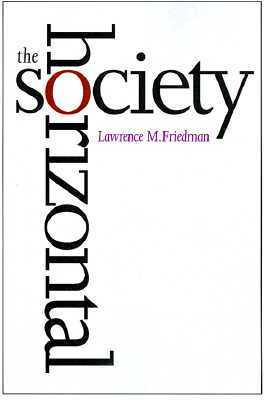
Modern technology has radically and irretrievably altered our sense of identity and hence our social, political, and legal life, argues Lawrence M. Friedman in this bold new book. In traditional societies, he explains, relationships and identities were strongly vertical : there was a clear line of authority from top to bottom, and identity was fixed by one’s birth or social position. But in modern society, identity and authority have become much more horizontal : people feel freer to choose who they are and to form relationships on a plane of equality. Friedman examines how modern life centers on human identity seen in terms of race, gender, ethnicity, and religion, and how this new way of defining oneself affects politics, social structure, and the law. Our horizontal society, he says, is the product of the mass media―in particular, television―which break down the isolation of traditional life and allow individuals to connect with like-minded others across barriers of space and time. As horizontal groups blossom, loyalties and allegiances to smaller groups fragment what seemed to be the unity of the larger nation. In addition, the media’s ability to spread a global mass culture causes a breakdown of cultural isolation that leads to more immigration and heavy pressure on the laws and institutions of citizenship and immigration.