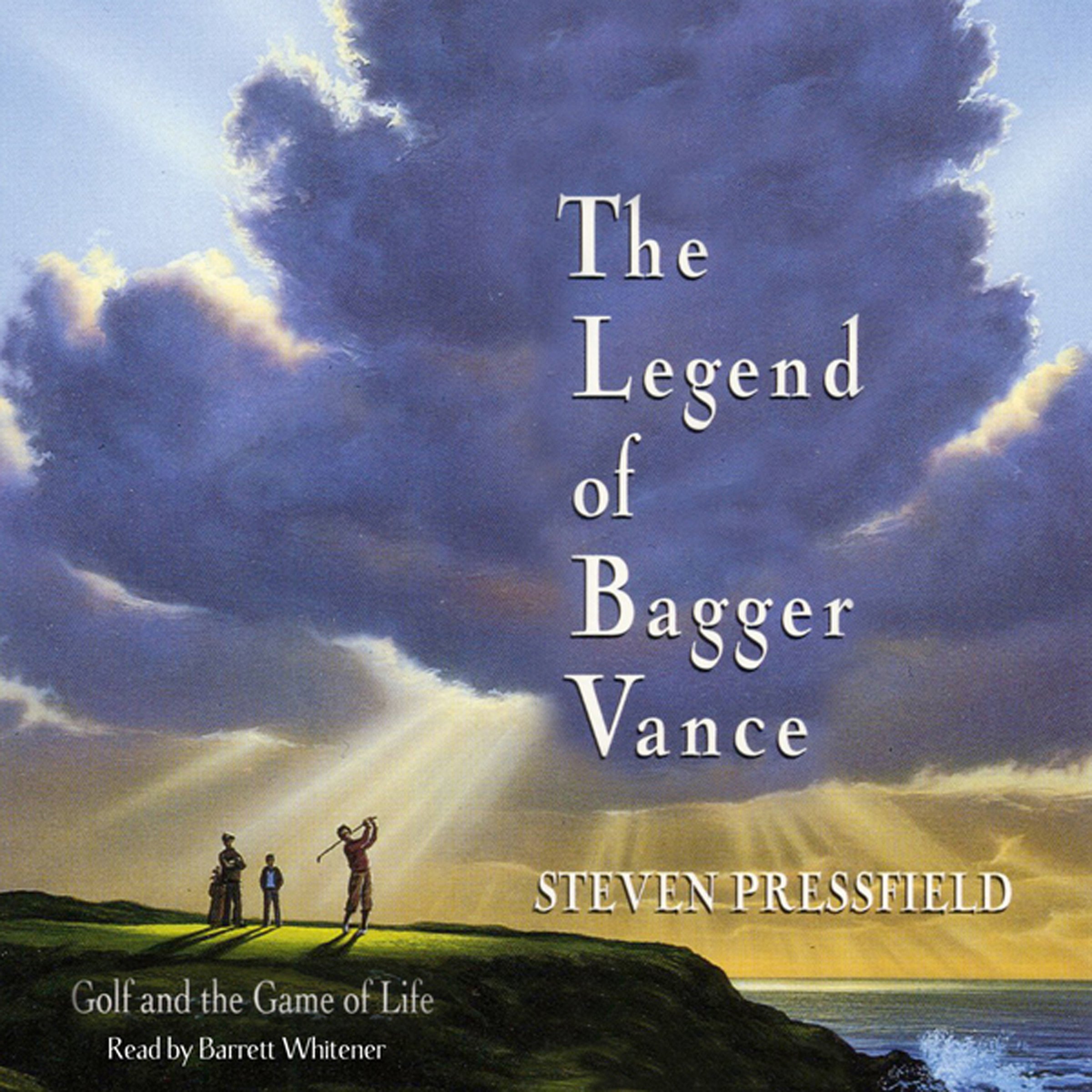
The 1931. The the golf links at Krewe Island off Savannah's windswept Atlantic shore. The a once-in-a-lifetime 36-hole match... in which the stakes are higher than anyone imagined. In Steven Pressfield's richly imagined, vividly detailed story, golf legends Bobby Jones and Walter Hagen are joined by a local unsung opponent, the troubled war hero Rannulph Junah. Played above raging Atlantic surf and under gathering storm clouds, their match is thrilling competition. But the key to the outcome lies with Bagger Vance, a caddie who carries the secret of the Authentic Swing. His mysterious powers guide the play and leave a lasting imprint on the lives he touches that day and in years to come. A sports fable worthy of comparison to The Natural, The Legend of Bagger Vance reveals that, in life as well as golf, the real battle is not with outside opponents but with oneself.
Author

I was born in Port of Spain, Trinidad, in 1943 to a Navy father and mother. I graduated from Duke University in 1965. In January of 1966, when I was on the bus leaving Parris Island as a freshly-minted Marine, I looked back and thought there was at least one good thing about this departure. "No matter what happens to me for the rest of my life, no one can ever send me back to this freakin' place again." Forty years later, to my surprise and gratification, I am far more closely bound to the young men of the Marine Corps and to all other dirt-eating, ground-pounding outfits than I could ever have imagined. GATES OF FIRE is one reason. Dog-eared paperbacks of this tale of the ancient Spartans have circulated throughout platoons of U.S. troops in Iraq and Afghanistan since the first days of the invasions. E-mails come in by hundreds. GATES OF FIRE is on the Commandant of the Marine Corps' Reading list. It is taught at West Point and Annapolis and at the Marine Corps Basic School at Quantico. TIDES OF WAR is on the curriculum of the Naval War College. From 2nd Battalion/6th Marines, which calls itself "the Spartans," to ODA 316 of the Special Forces, whose forearms are tattooed with the lambda of Lakedaemon, today's young warriors find a bond to their ancient precursors in the historical narratives of these novels. My struggles to earn a living as a writer (it took seventeen years to get the first paycheck) are detailed in my 2002 book, THE WAR OF ART. I have worked as an advertising copywriter, schoolteacher, tractor-trailer driver, bartender, oilfield roustabout and attendant in a mental hospital. I have picked fruit in Washington state and written screenplays in Tinseltown. With the publication of THE LEGEND OF BAGGER VANCE in 1995, I became a writer of books once and for all. My writing philosophy is, not surprisingly, a kind of warrior code—internal rather than external—in which the enemy is identified as those forms of self-sabotage that I have labeled "Resistance" with a capital R (in THE WAR OF ART) and the technique for combatting these foes can be described as "turning pro." I believe in previous lives. I believe in the Muse. I believe that books and music exist before they are written and that they are propelled into material being by their own imperative to be born, via the offices of those willing servants of discipline, imagination and inspiration, whom we call artists. My conception of the artist's role is a combination of reverence for the unknowable nature of "where it all comes from" and a no-nonsense, blue-collar demystification of the process by which this mystery is approached. In other words, a paradox. There's a recurring character in my books named Telamon, a mercenary of ancient days. Telamon doesn't say much. He rarely gets hurt or wounded. And he never seems to age. His view of the profession of arms is a lot like my conception of art and the artist: "It is one thing to study war, and another to live the warrior's life."