


Margins
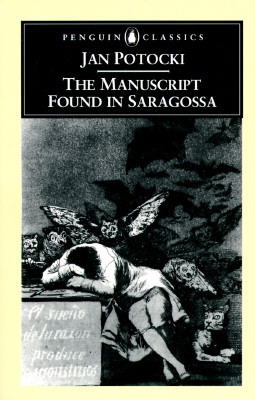
The Manuscript Found in Saragossa book cover
The Manuscript Found in Saragossa
1847
First Published
4.09
Average Rating
592
Number of Pages

¶ Originally published in Polish [as Rękopis Znaleziony w Saragossie, 1847], later translated into French as Manuscrit trouvé à Saragosse, the work is a supposed translation of a manuscript from the time of the Napoleonic Wars which depicts events several decades earlier. As for the plot - the plot! The Manuscript Found in Saragossa collects intertwining stories, all of them set in whole or in part in Spain, with a large and colorful cast of Gypsies, thieves, inquisitors, a cabbalist, a geometer, the cabbalist's beautiful sister, two Moorish princesses (Emina and Zibelda), and others. Alphonse, a young Walloon officer is travelling to join his regiment in Madrid in 1739. But he soon finds himself mysteriously detained at a highway inn in the strange and varied company of these thieves, brigands, cabbalists, noblemen, coquettes and gypsies. He records their stories over sixty-six days. The resulting manuscript is discovered some forty years later in a sealed casket, from which the tales of the characters, transformed through disguise, magic and illusion, of honour and cowardice, of hauntings and seductions, leap forth to create a vibrant polyphony of human voices. The novel's stories quickly overshadow van Worden's frame story. The bulk of the stories revolve around the Gypsy chief Avadoro, whose story becomes a frame story itself. Eventually the narrative focus moves again toward van Worden's frame story and a conspiracy involving an underground - or perhaps entirely hallucinated - Muslim society, revealing the connections and correspondences between the hundred or so stories told over the novel's sixty-six days. Jan Potocki (1761-1812) used a range of literary styles - gothic, picaresque, adventure, pastoral, erotica - in his novel of stories-within-stories - which provides entertainment on an epic scale. The stories cover a wide range of genres and as a whole the novel reflects Potocki's far-ranging interests, especially his deep fascination with secret societies, the supernatural, and "Oriental" cultures. These "stories-within-stories" sometimes reach several levels of depth, and characters and themes - a few prominent themes being honor, disguise, metamorphosis, and conspiracy - recur and change shape throughout. Because of its rich and varied interlocking structure, the novel echoes favorable comparison to many celebrated literary antecedents such as the ancient BCE Jatakas and Panchatantra as well as the medieval Arabian Nights and Decameron.
Avg Rating
4.09
Number of Ratings
4,115
5 STARS
42%
4 STARS
33%
3 STARS
18%
2 STARS
5%
1 STARS
2%
goodreads

Author

Jan Potocki
Jan Potocki
Author · 5 books

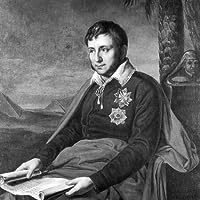
Jan Potocki was born into the Potocki family, an aristocratic family, that owned vast estates in Poland. He was educated in Geneva and Lausanne, served twice in the Polish Army as a captain of engineers, and spent some time on a galley as a novice Knight of Malta. He was probably a Freemason and had a strong interest in the occult. Potocki's colorful life took him across Europe, Asia and North Africa, where he embroiled himself in political intrigues, flirted with secret societies, contributed to the birth of ethnology—he was one of the first to study the precursors of the Slavic peoples from a linguistic and historical standpoint. In 1790 he became the first person in Poland to fly in a hot air balloon when he made an ascent over Warsaw with the aeronaut Jean-Pierre Blanchard, an exploit that earned him great public acclaim. He also established in 1788 in Warsaw a publishing house named Drukarnia Wolna (Free Press) as well as the city's first free reading room. Potocki's wealth enabled him to travel extensively about Europe, the Mediterranean and Asia, visiting Italy, Sicily, Malta, the Netherlands, Germany, France, England, Russia, Turkey, Spain, Tunisia, Morocco, Egypt, and even Mongolia. He was also one of the first travel writers of the modern era, penning lively accounts of many of his journeys, during which he also undertook extensive historical, linguistic and ethnographic studies. As well as his many scholarly and travel writings, he also wrote a play, a series of sketches and a novel. Potocki married twice and had five children. His first marriage ended in divorce, and both marriages were the subject of scandalous rumors. In 1812, disillusioned and in poor health, he retired to his estate at Uladowka in Podolia, suffering from "melancholia" (which today would probably be diagnosed as depression), and during the last few years of his life he completed his novel. Potocki committed suicide in December 1815 at the age of 54, though the exact date is uncertain—possibly November 20, December 2 or December 11. There are also several versions of the circumstances of his death; the best-known story is that he shot himself in the head with a silver bullet—fashioned from the strawberry-shaped knob of a sugar bowl given to him by his mother—which he first had blessed by his castle priest. One version of Potocki's suicide suggests that he gradually filed the knob off the lid, a little every morning. Potocki's most famous work is The Manuscript Found in Saragossa. Originally written in French as Manuscrit trouvé à Saragosse, it is a frame tale which he wrote to entertain his wife. On account of its rich interlocking structure and telescoping story sequences, the novel has drawn comparisons to such celebrated works as the Decameron and the Arabian Nights.

548 Market St PMB 65688, San Francisco California 94104-5401 USA
© 2026 Paratext Inc. All rights reserved