Margins




548 Market St PMB 65688, San Francisco California 94104-5401 USA
© 2026 Paratext Inc. All rights reserved
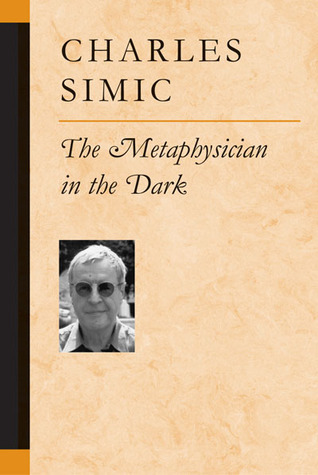
Charles Simic's quicksilver imagination, his masterly way with words, and his unalloyed love of life and language alike inform every page of this wonderfully wide-ranging collection. Again and again, Simic takes up a subject and turns it this way and that, showing us what we haven't noticed before, inviting us to share an infectious delight that turns everything, in the end, into poetry. It's a gift that has won him a coveted MacArthur Fellowship, among many honors, but he wears his magic lightly. Often, he addresses poetry itself. Among the pieces here are appreciations of Mark Strand, James Merrill, John Ashbery, and James Tate, each evaluated with a keen eye tempered by a generous spirit. Other essays discuss Joseph Brodsky, Czeslaw Milosz, and Vasko Popa; to these writers he brings the understanding available only to those who can read them in the original. In considering Brodsky's translations, for instance, he offers insights regarding not only the poet himself but the very nature of language. Elsewhere, he peers into poetry's past and its as a vessel of memory, a witness to history, and a mirror of human experience. But perhaps the greatest pleasures afforded by The Metaphysician in the Dark, as he styles himself with a beguiling mix of modesty and irony, appear when Simic goes further afield. His look at the deadpan comedy of Buster Keaton is as revealing of the author as of the actor and his craft; his perusal of a Heironymous Bosch altarpiece captures both the painter's sense of apocalypse and a riotous joy in the piling of detail upon detail; his review of a book on Joseph Cornell examines how obsession becomes art. He is fluently familiar with subjects as diverse as Saul Bellow's novels and Aberlardo Morell's extraordinary camera obscura photographs. Yet when he takes the gloves off, as in two essays on the Serbia of Slobodan Milosevic, his outrage is as forceful as his pride is strong in his own Serbian heritage. Each of the two dozen essays here reflects a sophistication irresistible in its simplicity; taken together, they display a questing intelligence and a panorama of life and art. Charles Simic is an acclaimed poet, novelist, essayist and teacher. Winner of a MacArthur Fellowship and a Pulitzer Prize, he is the author of more than twenty volumes of poetry and six books of prose, as well as numerous translations. He is Distinguished University Professor of English at the University of New Hampshire, where he has taught since 1973.