Margins
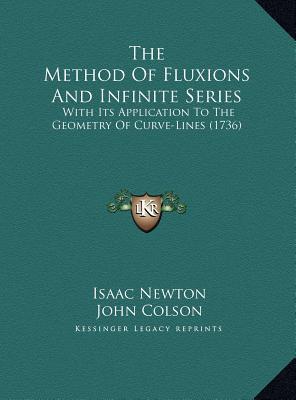
The Method Of Fluxions And Infinite Series book cover
The Method Of Fluxions And Infinite Series
With Its Application To The Geometry Of Curve-Lines
2010
First Published
4.00
Average Rating
369
Number of Pages
The Method of Fluxions and Infinite With Its Application to the Geometry of Curve-Lines is a book written by the renowned English mathematician and physicist, Sir Isaac Newton. Originally published in 1736, the book is a comprehensive treatise on the subject of calculus, which Newton himself had developed in the late 17th century.The book is divided into two parts. The first part deals with the concept of fluxions, which is Newton's term for what is now known as derivatives. The second part covers infinite series, which are used to represent functions as a sum of infinitely many terms. These concepts are the foundation of calculus, and the book provides a detailed explanation of their development and application.In addition to the mathematical theory, the book also includes practical examples and applications of calculus to the geometry of curve-lines. Newton uses this to demonstrate how calculus can be used to solve real-world problems, such as the determination of the area and length of curves.Overall, The Method of Fluxions and Infinite Series is a seminal work in the history of mathematics, and remains a valuable resource for students and scholars of calculus and mathematical physics.This scarce antiquarian book is a facsimile reprint of the old original and may contain some imperfections such as library marks and notations. Because we believe this work is culturally important, we have made it available as part of our commitment for protecting, preserving, and promoting the world's literature in affordable, high quality, modern editions, that are true to their original work.

Avg Rating
4.00
Number of Ratings
3
5 STARS
33%
4 STARS
33%
3 STARS
33%
2 STARS
0%
1 STARS
0%
goodreads

Authors

Isaac Newton
Isaac Newton
Author · 16 books

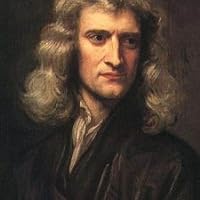
Sir Isaac Newton, FRS, was an English physicist, mathematician, astronomer, natural philosopher, and alchemist. His Philosophiæ Naturalis Principia Mathematica, published in 1687, is considered to be the most influential book in the history of science. In this work, Newton described universal gravitation and the three laws of motion, laying the groundwork for classical mechanics, which dominated the scientific view of the physical universe for the next three centuries and is the basis for modern engineering. Newton showed that the motions of objects on Earth and of celestial bodies are governed by the same set of natural laws by demonstrating the consistency between Kepler's laws of planetary motion and his theory of gravitation, thus removing the last doubts about heliocentrism and advancing the scientific revolution. In mechanics, Newton enunciated the principles of conservation of momentum and angular momentum. In optics, he invented the reflecting telescope and developed a theory of colour based on the observation that a prism decomposes white light into a visible spectrum. He also formulated an empirical law of cooling and studied the speed of sound. In mathematics, Newton shares the credit with Gottfried Leibniz for the development of the differential and integral calculus. He also demonstrated the generalised binomial theorem, developed the so-called "Newton's method" for approximating the zeroes of a function, and contributed to the study of power series. Newton was also highly religious (though unorthodox), producing more work on Biblical hermeneutics than the natural science he is remembered for today. In a 2005 poll of the Royal Society asking who had the greater effect on the history of science, Newton was deemed much more influential than Albert Einstein.

548 Market St PMB 65688, San Francisco California 94104-5401 USA
© 2025 Paratext Inc. All rights reserved