Margins
Margins
548 Market St PMB 65688, San Francisco California 94104-5401 USA
hello@margins.app
·
+1 (650) 223-5283
Privacy Policy
·
Terms of Use
© 2026 Paratext Inc. All rights reserved
The New Cambridge Medieval History
The New Cambridge Medieval History
Series · 9 books · 1995-2015
By
Paul Fouracre
,
Rosamond McKitterick
,
Timothy Reuter
, and more
Books in series
#1
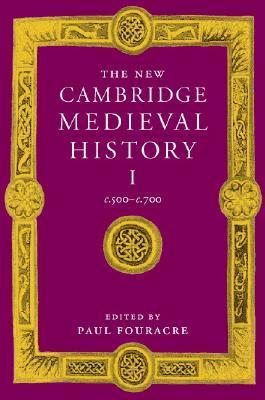
The New Cambridge Medieval History, Volume 1
2005
The first volume of The New Cambridge Medieval History covers the transitional period between the later Roman world and the early middle ages, c.500 to c.700. This was an era of developing consciousness and profound change in Europe, Byzantium and the Arab world, an era in which the foundations of medieval society were laid and to which many of our modern myths of national and religious identity can be traced. This book offers a comprehensive regional survey of the sixth and seventh centuries, from Ireland in the west to the rise of Islam in the Middle East, and from Scandinavia in the north to the Mediterranean south. It explores the key themes pinning together the history of this period, from kingship, trade and the church, to art, architecture and education. It represents both an invaluable conspectus of current scholarship and an expert introduction to the period.
#2
The New Cambridge Medieval History, Volume 2
1995
This volume of The New Cambridge Medieval History covers most of the period of Frankish and Carolingian dominance in western Europe. It was one of remarkable political and cultural coherence, combined with crucial, very diverse and formative developments in every sphere of life. Adopting an interdisciplinary approach, the authors examine the interaction between rulers and ruled, how power and authority actually worked, and the society and culture of Europe as a whole. The volume is divided into four parts. Part I encompasses the events and political developments in the whole of the British Isles, the west and east Frankish kingdoms, Scandinavia, the Slavic and Balkan regions, Spain, Italy, and those aspects of Byzantine and Muslim history which impinged on the west between c. 700 and c. 900. Parts II, III and IV cover themes and topics concerning church and society, and cultural and intellectual developments.
#3
The New Cambridge Medieval History, Volume 3
2000
The period of the tenth and early eleventh centuries was crucial in the formation of Europe, much of whose political geography and larger-scale divisions began to take shape at that time. It was also an era of great fragmentation, and hence of differences that have been magnified by modern national historiographical traditions. This volume of The New Cambridge Medieval History reflects these varying traditions, and provides an authoritative survey in its own terms. The volume is divided into three general themes, the former Carolingian lands, and areas farther afield.
#4.1
The New Cambridge Medieval History, Volume 4
2004
The fourth volume of The New Cambridge Medieval History covers the eleventh and twelfth centuries, which comprised the most dynamic period in the European Middle Ages. The first of two parts, this volume deals with ecclesiastical and secular themes, in addition to major developments such as the expansion of population, agriculture, trade, and towns; the radical reform of the Western Church; the appearance of new kingdoms and states, the Crusades, knighthood and law; and the development of literature, art and architecture, heresies and the scholastic movement.
#4.2
The New Cambridge Medieval History, Volume 4
2015
The second part of the volume is about the course of events—ecclesiastical and secular—with regard to the papacy, the western empire (mainly Germany), Italy, France, Spain, the British Isles, Scandinavia, Hungary, Poland, the Byzantine empire and the settlements in Palestine and Syria established by the crusades and their Muslim neighbors.
#5
The New Cambridge Medieval History, Volume 5
1999
Volume 5 brings together studies of the political, religious, social and economic history of the whole of Europe and of the Mediterranean world between about 1198 and 1300. Comprehensive coverage of the developments in western Europe is balanced by attention to the east of Europe, including the Byzantine world, and the Islamic lands in Spain, north Africa and the Levant. Thematic articles look at the fine arts, the vernacular, communications and other aspects of a period in which the frontiers of Latin Christendom were expanding vigorously outward. Attention also is paid to the frontier societies that emerged in Spain, the Baltic and the Mediterranean islands.
#6
The New Cambridge Medieval History, Volume 6
2000
The sixth volume of The New Cambridge Medieval History offers an authoritative synthesis of the major themes in European fourteenth-century history, written by leading British, continental and American scholars. It provides a wide-ranging account of a period of major social, political and cultural change, punctuated by the greatest natural disaster experienced by mankind, the Black Death. Illustrated by maps, figures and plates, and furnished with detailed bibliographies, it will be indispensable to anyone interested in the development of Christendom during the period and its relations with other civilizations.
#7
The New Cambridge Medieval History, Volume 7
1998
This seventh volume of The New Cambridge Medieval History covers the last century (interpreted broadly) of the traditional Western Middle Ages. It takes account of much new research and modern, interdisciplinary approaches to the study and writing of history to present a broad view of late medieval society across Europe. It deals with ideas about government, social and economic change and development, the world of the spirit, as well as the history of individual countries, in many of which the powers of central government were greatly extended.
#9
The New Cambridge Medieval History 7 Volume Set in 8 Pieces
1998
The publication of The New Cambridge Medieval History is a major landmark in the field of historical publishing. Written by leading international scholars and incorporating the very latest research, the History will become the essential reference tool for anyone interested in the medieval world. The original Cambridge Medieval History was published between 1911 and 1936, with a new edition of Volume 4 appearing in the 1960s. That famous series is now out of print, and is being replaced by The New Cambridge Medieval History which will present a reliable, detailed history from late antiquity to c.1500. To be published in seven volumes, with volume 4 divided into two parts, it will provide a unique, authoritative guide to medieval life and thought.
Authors
Paul Fouracre
Author · 2 books
Rosamond McKitterick
Author · 9 books
Timothy Reuter
Author · 3 books
David E. Luscombe
Author · 3 books
David Abulafia
Author · 11 books
Christopher Allmand
Author · 3 books