Margins




548 Market St PMB 65688, San Francisco California 94104-5401 USA
© 2026 Paratext Inc. All rights reserved
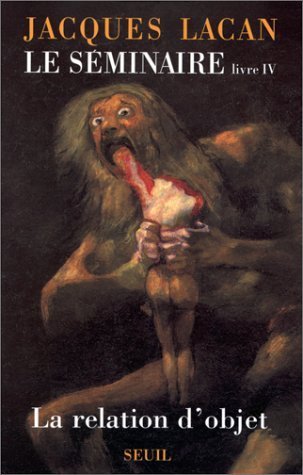
'The unfulfilled and unsatisfied mother around whom the child ascends the upward slope of his narcissism is someone real. She is right there, and like all other unfulfilled creatures, she is in search of what she can devour, quaerens quem devoret. What the child once found as a means of quashing the symbolic unfulfilment is what he may possibly find across from him again as a wide-open maw [...] To be devoured is a grave danger that our fantasies reveal to us. We find it at the origin, and we find it again at this turn in the path where it yields us the essential form in which phobia presents. We find it again when we look at the fears of Little Hans [...] With the support of what I have shown you today, you will better see the relationships between phobia and perversion [...] I shall go so far as to say that you will interpret the case better than did Freud himself [...]' Extract from Chapter XI '[...] it's no accident that what has been perceived but dimly, yet perceived nevertheless, is that castration bears just as much relation to the mother as to the father. We can see in the description of the primordial situation how maternal castration implies for the child the possibility of devoration and biting. In relation to this anteriority of maternal castration, paternal castration is a substitute [...]' Extract from Chapter XXI '[In the case of little Hans] The initial transformation, which will prove decisive, is [...] the transformation of the biting into the unscrewing of the bathtub, which is something utterly different, in particular for the relationship between the protagonists. Voraciously to bite the mother, as an act or an apprehension of her altogether natural signification, indeed to dread in return the notorious biting that is incarnated by the horse, is something quite different from unscrewing, from ousting, the mother, and mobilising her in this business, bringing her into the system as a whole, for this first time as a mobile element and, by like token, an element that is equivalent to all the rest.' Extract from Chapter XXIII