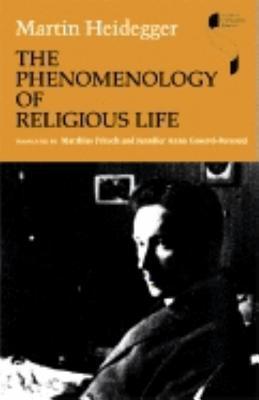
The Phenomenology of Religious Life
1927
First Published
4.09
Average Rating
283
Number of Pages
The Phenomenology of Religious Life presents the text of Heidegger's important 1920—21 lectures on religion. The volume consists of the famous lecture course Introduction to the Phenomenology of Religion, a course on Augustine and Neoplatonism, and notes for a course on The Philosophical Foundations of Medieval Mysticism that was never delivered. Heidegger's engagements with Aristotle, St. Paul, Augustine, and Luther give readers a sense of what phenomenology would come to mean in the mature expression of his thought. Heidegger reveals an impressive display of theological knowledge, protecting Christian life experience from Greek philosophy and defending Paul against Nietzsche.

Avg Rating
4.09
Number of Ratings
120
5 STARS
38%
4 STARS
39%
3 STARS
18%
2 STARS
3%
1 STARS
2%
goodreads
Author

Martin Heidegger
Author · 91 books
Martin Heidegger (1889-1976) was a German philosopher whose work is perhaps most readily associated with phenomenology and existentialism, although his thinking should be identified as part of such philosophical movements only with extreme care and qualification. His ideas have exerted a seminal influence on the development of contemporary European philosophy. They have also had an impact far beyond philosophy, for example in architectural theory (see e.g., Sharr 2007), literary criticism (see e.g., Ziarek 1989), theology (see e.g., Caputo 1993), psychotherapy (see e.g., Binswanger 1943/1964, Guignon 1993) and cognitive science (see e.g., Dreyfus 1992, 2008; Wheeler 2005; Kiverstein and Wheeler forthcoming).