


Margins
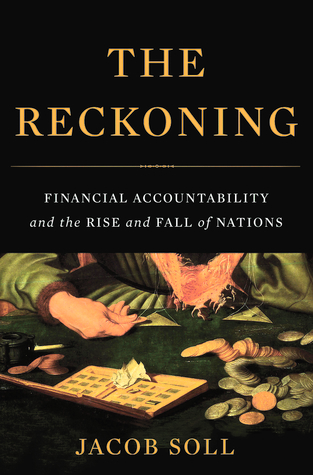
The Reckoning book cover
The Reckoning
Financial Accountability and the Rise and Fall of Nations
2014
First Published
3.88
Average Rating
314
Number of Pages

A “brilliant” (Los Angeles Review of Books) history of accounting, showing how financial and political accountability has shaped the rise and fall of nations and empires Whether building a road or fighting a war, leaders from ancient Mesopotamia to the present have relied on financial accounting to track their state's assets and guide its policies. Basic accounting tools such as auditing and double-entry bookkeeping form the basis of modern capitalism and the nation-state. Yet our appreciation for accounting and its formative role throughout history remains minimal at best-and we remain ignorant at our peril. Poor or risky practices can shake, and even bring down, entire societies. In The Reckoning, historian and MacArthur "Genius" Award-winner Jacob Soll presents a sweeping history of accounting, drawing on a wealth of examples from over a millennia of human history to reveal how accounting has shaped kingdoms, empires, and entire civilizations. The Medici family of 15th century Florence used the double-entry method to win the loyalty of their clients, but eventually began to misrepresent their accounts, ultimately contributing to the economic decline of the Florentine state itself. In the 17th and 18th centuries, European rulers shunned honest accounting, understanding that accurate bookkeeping would constrain their spending and throw their legitimacy into question. And in fact, when King Louis XVI's director of finances published the crown's accounts in 1781, his revelations provoked a public outcry that helped to fuel the French Revolution. When transparent accounting finally took hold in the 19th Century, the practice helped England establish a global empire. But both inept and willfully misused accounting persist, as the catastrophic Stock Market Crash of 1929 and the Great Recession of 2008 have made all too clear. A masterwork of economic and political history, and a radically new perspective on the recent past, The Reckoning compels us to see how accounting is an essential instrument of great institutions and nations-and one that, in our increasingly transparent and interconnected world, has never been more vital.

Avg Rating
3.88
Number of Ratings
356
5 STARS
26%
4 STARS
44%
3 STARS
21%
2 STARS
7%
1 STARS
1%
goodreads

Author

Jacob Soll
Jacob Soll
Author · 5 books

Jacob Soll is professor of history and accounting at the University of Southern California. He received a B.A. from the University of Iowa, a D.E.A. from the École des Hautes Études en Sciences Sociales in Paris, France, and a Ph.D. from Magdalene College, Cambridge University. He has been awarded numerous prestigious prizes including two NEH Fellowships, the Jacques Barzun Prize, a Guggenheim Fellowship, and, in 2011, the MacArthur Fellowship. Soll’s first book, "Publishing The Prince" (2005), examines how Machiavelli's work was popularized and influenced modern political thought. It won the Jacques Barzun Prize from the American Philosophical Society. In his second book, The Information Master (2009), Soll investigates how Louis XIV's famous finance minister Jean-Baptiste Colbert fused financial management and library sciences to create one of the first modern information states. His most recent book, The Reckoning: Financial Accountability and the Rise and Fall of Nations (2014), presents a sweeping history of accounting and politics, drawing on a wealth of examples from over a millennia of human history to reveal how accounting can used to both build kingdoms, empires and entire civilizations, but also to undermine them. It explains the origins of our own financial crisis as deeply rooted in a long disconnect between human beings and their attempts to manage financial numbers. The Reckoning, reviewed in major newspapers and publications around the world, has sold more than 60,000 copies worldwide, and has been translated into five languages. His new books include Free Market: The History of a Dream (Basic Books), an analysis of classical philosophy, natural law, history and contemporary economic culture; a history of libraries and Enlightenment (Yale University Press); and the first English edition of Jean-Baptiste Colbert’s economic writings (Anthem). Soll has been a correspondent for the Boston Globe, and a regular contributor to the New York Times, Politico, the New Republic, PBS, Salon.com and the Chronicle of Higher Education. Soll is currently meeting with political and financial leaders across the globe to promote accounting standards and financial transparency. Recent journal and chapter publications include: • “Jean Baptiste Colbert: Accounting and the Genesis of a State Archive in Early Modern France,” Proceedings of the British Society, forthcoming 2017. • “From Virtue to Surplus: Jacques Necker’s Compte Rendu (1781) and the Origins of Modern Political Discourse,” Representations 134 (216), pp. 29-63. • “The Grafton Method, or the Science of Tradition,” in Ann Blair and Anja-Silvia Goeing, eds., For the Sake of Learning: Essays in Honor of Anthony Grafton, 2 vols. (Leiden: Brill, 2016), 2, pp. 1019-1032. • “Intellectual History and the History of the Book,” in Richard Whatmore and Brian Young, eds. A Companion to Intellectual History, (Chichester: John Wiley And Sons/Blackwell, 2016), pp. 72-82.

548 Market St PMB 65688, San Francisco California 94104-5401 USA
© 2026 Paratext Inc. All rights reserved