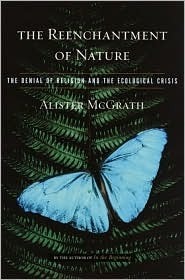
In this provocative assessment of the world's current ecological crisis, the author of the critically acclaimed In the Beginning exposes the false assumptions underlying the conflicts between science and religion, and proposes an innovative approach to saving the planet. Traditionally, science and religion have been thought of as two distinct and irreconcilable ways of looking at the world, and scientists have often chastised the world's religions for keeping their eyes on the heavens and paying scant attention to the destruction of Earth's precious resources and its natural wonders. In The Reenchantment of Nature, Alister McGrath, who holds doctorates in both molecular biology and divinity, challenges this long-held and dangerously misguided dichotomy. Arguing that Christianity and other great religions have always respected and revered the bounty and beauty of the earth, McGrath calls for a radical shift in perspective. He shows that by defining the world in the narrowest of scientific terms and viewing it as a collection of atoms and molecules governed by unchanging laws and forces, we have lost our ability to appreciate nature's enchantments. In order to address the threats to our environment, he maintains, it is essential to reawaken our sense of awe and look at the world as a glorious creation, an irreplaceable gift of God. In setting forth a new framework for the debate between science and religion on ecological theory, The Reenchantment of Nature points the way to integrating two different traditions in a sane and productive effort to rescue the natural world from its present environmental decline.
Author

Alister Edgar McGrath is a Northern Irish theologian, priest, intellectual historian, scientist, and Christian apologist. He currently holds the Andreas Idreos Professorship in Science and Religion in the Faculty of Theology and Religion at the University of Oxford, and is Professor of Divinity at Gresham College. He was previously Professor of Theology, Ministry, and Education at King's College London and Head of the Centre for Theology, Religion and Culture, Professor of Historical Theology at the University of Oxford, and was principal of Wycliffe Hall, Oxford, until 2005. He is an Anglican priest and is ordained within the Church of England. Aside from being a faculty member at Oxford, McGrath has also taught at Cambridge University and is a Teaching Fellow at Regent College. McGrath holds three doctorates from the University of Oxford, a DPhil in Molecular Biophysics, a Doctor of Divinity in Theology and a Doctor of Letters in Intellectual History. McGrath is noted for his work in historical theology, systematic theology, and the relationship between science and religion, as well as his writings on apologetics. He is also known for his opposition to New Atheism and antireligionism and his advocacy of theological critical realism. Among his best-known books are The Twilight of Atheism, The Dawkins Delusion?: Atheist Fundamentalism and the Denial of the Divine, Dawkins' God: Genes, Memes, and the Meaning of Life, and A Scientific Theology. He is also the author of a number of popular textbooks on theology.