2014
First Published
3.80
Average Rating
344
Number of Pages
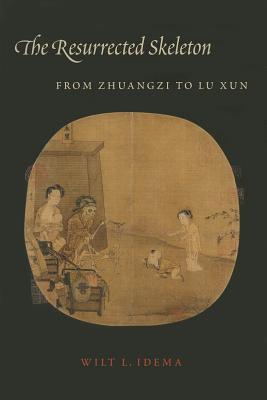
The Chinese philosopher Zhuangzi (369—286 B.C.E.) encountered a skull that later in a dream praises the pleasures of death over the toil of living. This anecdote became popular with poets in the second and third centuries and found renewed significance with the founders of Quanzhen Daoism. These philosophers turned the skull into a skeleton, a metonym for death and a symbol of the refusal of enlightenment. Popular throughout the Ming dynasty (1368—1644) and reenvisioned by the fiction writer Lu Xun (1881—1936), the legend echoes transformations in Chinese philosophy and culture. The first book in English to trace the resurrected skeleton, this text translates major adaptations while drawing parallels to Jesus' encounter with a skull and the European tradition of the Dance of Death.

Avg Rating
3.80
Number of Ratings
10
5 STARS
30%
4 STARS
40%
3 STARS
20%
2 STARS
0%
1 STARS
10%
goodreads
Author
Wilt L. Idema
Author · 4 books
Wilt L. Idema obtained his BA and MA from Leiden University. Following continued study in Sapporo (at Hokkaido University) and in Kyoto (at Kyoto University), and research in Hong Kong (at the Universities Service Center), he returned to Leiden, where he taught in the Department of Chinese Language and Culture. He obtained his doctorate in 1974, and was promoted to Professor of Chinese Literature and Linguistics in 1976. Since 2000, he has been teaching at Harvard as Professor of Chinese Literature. Wilt Idema's research initially was focused on the early development of Chinese vernacular fiction (Chinese Vernacular Fiction: The Formative Period, 1974), but later shifted more towards early Chinese drama (Chinese Theater 1100-1450, A Source Book, with Stephen West; 1982; The Dramatic Oeuvre of Chu Yu-tun (1379-1439), 1985; Wang Shifu, The Moon and the Zither: The Story of the Western Wing, with Stephen H. West, 1992). In recent years he also has published on Chinese women's literature of the premodern period (The Red Brush: Writing Women of Imperial China, with Beata Grant, 2004). His current research is focused on China's rich tradition of popular narrative ballads. He is also the author, with Lloyd Haft, of A Guide to Chinese Literature (1997). For his voluminous Dutch-language translations, especially of classical Chinese poetry, he received the Martinus Nijhof Award for 1991, the highest distinction for literary translations in the Netherlands.