Margins
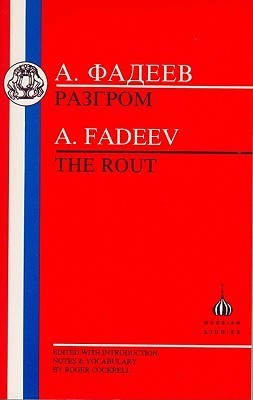
The Rout book cover
The Rout
1926
First Published
3.32
Average Rating
222
Number of Pages
This is a title in the Bristol Classical Press Russian Texts series, in Russian with English notes, vocabulary and introduction. Aleksander Fadeev's "Razgrom" ("The Rout", 1927) is set in the far eastern region of Russia, and tells the story of a group of Bolshevik partisans. Among the novel's implicit themes are the nature of leadership, the question of freedom and responsibility and the conflict between selfishness and altruism. Although "The Rout" is the work of an ideologically committed writer, it also reflects its author's interest in the traditions of 19th-century Russian literature.

Avg Rating
3.32
Number of Ratings
193
5 STARS
16%
4 STARS
29%
3 STARS
35%
2 STARS
11%
1 STARS
9%
goodreads

Author

Alexander Fadeyev
Alexander Fadeyev
Author · 4 books

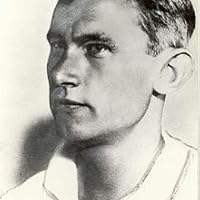
Alexander Alexandrovich Fadeyev (Russian: Александр Алексaндрович Фадеев) was a Soviet writer, one of the co-founders of the Union of Soviet Writers and its chairman from 1946 to 1954. From 1908 to 1912 he lived in Chuguyevka, Primorsky Krai. He took part in the guerrilla movement against the Japanese interventionists and the White Army during the Russian Civil War. In 1927, he published the novel The Rout (also known as The Nineteen), in which he described youthful guerrilla fighters. In 1945 he wrote the novel Young Guard (based upon real events of World War II) about the underground anti-fascist Komsomol organization named Young Guard, which fought against the Nazis in the occupied city Krasnodon (in the Ukrainian SSR). For this novel, Fadeyev was awarded the Stalin Prize (1946). In 1948, a Soviet film The Young Guard, based on the book, was released, and later revised in 1964 to correct inaccuracies in the book. Fadeyev was a champion of Joseph Stalin, proclaiming him "the greatest humanist the world has ever known". During the 1940s, he actively promoted Zhdanovshchina, a campaign of criticism and persecution against many of the Soviet Union's foremost composers. However, he was a friend of Mikhail Sholokhov. Fadeyev married a famous stage actress, Angelina Stepanova (1905–2000). In the last years of his life Fadeyev became an alcoholic. Some sources claim, that this was mostly due to the denunciation of Stalinism during the Khrushchev Thaw. He eventually committed suicide at his dacha in Peredelkino, leaving a dying letter, from which one can see Fadeyev's strictly negative attitude to new leaders of the Party. His death occasioned an epigram by Boris Pasternak, his neighbor. Alexander Fadeyev is buried in the Novodevichy Cemetery in Moscow.

548 Market St PMB 65688, San Francisco California 94104-5401 USA
© 2026 Paratext Inc. All rights reserved