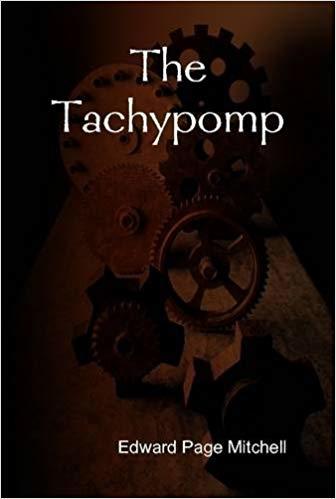



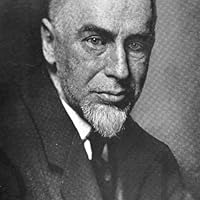
Edward Page Mitchell was born in Bath, Maine on 24th March 1852 into a wealthy family. When he was eight the family moved to a house on New York’s famed Fifth Avenue. In 1863 he witnessed the Draft Riots and in the aftermath Mitchell's father moved the family to Tar River, North Carolina. It was there, at the age of fourteen, that his letters were first published in the local newspaper The Bath Times. In 1872, at age twenty, whilst on a train journey to Bath, Maine, a hot cinder from the engine's smokestack flew in through the window blinding his left eye. After several weeks, while doctors attempted to restore his sight, his uninjured right eye underwent sympathetic blindness. He was now completely blind. His burnt left eye eventually regained its sight, but his uninjured right eye remained blind and was later replaced with a prosthetic glass eye. While recovering from this surgery, Mitchell wrote his dazzling story ‘The Tachypomp’. Mitchell’s influence on science fiction writing is incredible and pre-dated many major themes. He wrote about a man made invisible, a time-travel machine, a thinking computer, teleportation, superior mutants and mind transfer. Add to this other stories which predicted travel by pneumatic tube, electrical heating, newspapers printed at home, food-pellet concentrates, international broadcasts, and suspended animation through cryogenics and they amount to talents that are not as publicly lauded as they should be. Edward Page Mitchell died of a cerebral hemorrhage in New London, Connecticut on 22nd January 1927. He was 76. The Tachypomp is a glorious mixture of a youth looking to impress his prospective father-in-law with a seemingly outlandish solution to a scientific problem.
Author

"Edward Page Mitchell (1852–1927) was an American editorial and short story writer for The Sun, a daily newspaper in New York City. He became that newspaper's editor in 1897, succeeding Charles Anderson Dana. Mitchell was recognized as a major figure in the early development of the science fiction genre. Mitchell wrote fiction about a man rendered invisible by scientific means ("The Crystal Man", published in 1881) before H.G. Wells' The Invisible Man, wrote about a time-travel machine ("The Clock that Went Backward") before Wells' The Time Machine, wrote about faster-than-light travel ("The Tachypomp"; now perhaps his best-known work) in 1874, a thinking computer and a cyborg in 1879 ("The Ablest Man in the World"), and also wrote the earliest known stories about matter transmission or teleportation ("The Man without a Body", 1877) and a superior mutant ("Old Squids and Little Speller"). "Exchanging Their Souls" (1877) is one of the earliest fictional accounts of mind transfer. Mitchell retired in 1926, a year before dying of a cerebral hemorrhage. The gradual rediscovery of Mitchell and his work is a direct result of the publication in 1973 of a book-length anthology of his stories, compiled by Sam Moskowitz with a detailed introduction by Moskowitz giving much information about Mitchell's personal life. Because Mitchell's stories were not by-lined on original publication, nor indexed, Moskowitz expended major effort to track down and collect these works by an author whom Moskowitz cited as "the lost giant of American science fiction". Mitchell's stories show the strong influence of Edgar Allan Poe. Among other traits, Mitchell shares Poe's habit of giving a basically serious and dignified fictional character a jokey name, such as "Professor Dummkopf" in Mitchell's "The Man Without a Body". Since Mitchell's fictions were originally published in newspapers, typeset in the same format as news articles and not identified as fiction, he may possibly have used this device to signal to his readers that this text should not be taken seriously." — Wikipedia