


Margins
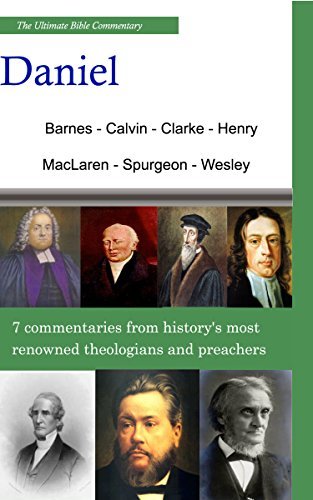
The Ultimate Commentary On Daniel book cover
The Ultimate Commentary On Daniel
A Collective Wisdom On The Bible
1853
First Published
3.33
Average Rating
246
Number of Pages

THE ULTIMATE COMMENTARY ON DANIEL Too often we forget the wisdom of the past. We are fortunate to be left a great legacy of Bible study. The past, both recent and distant, had many great students of God’s Word, the Bible. This publication, The Ultimate Commentary, brings you 7 different insights into Daniel. ALBERT BARNES Albert Barnes (1798-1870) was a distinguished theologian from New York State, USA. In addition to his studies he was an ordained Presbyterian Minister and pastored Churches in New Jersey and Philadelphia. JOHN CALVIN One of the father’s of the Reformation, John Calvin, has been given a prominent place in today’s theology. Indeed his very name has been lent to a system of theology – Calvanism. ADAM CLARKE After John Wesley, Adam Clarke is probably the best known Methodist theologian Clarke’s greatest contribution to Christians all over the world is his commentary on the Bible, a work that took 40 years to complete. This commentary was the main resource for Methodists for over two hundred years! MATTHEW HENRY Matthew Henry (18 October 1662 - 22 June 1714) is renowned for his commentary 300 years after his death. Born in Wales, Henry grew up to study theology and law. In 1687 he became a Presbyterian minister in Chester where he founded a school. His six volumes, Exposition Of The Old & New Testaments, were completed in 1710 and are a treasure trove of Scriptural insight and assistance. CHARLES H. SPURGEON The Prince of Preachers, Charles H. Spurgeon (19th June 1834 – 31 January 1892) was not only a wonderful orator but also magnificent with his pen. The sermons he preached touched the lives of thousands. His writings still continue to reach those who read them to this very day. In addition to his commentaries we have included each sermon he preached through this book. Reading Spurgeon today may be secondary to the impossibility of hearing him but there is no doubt that his words still carry the weight of Biblical truth. JOHN WESLEY John Wesley (along with his brother Charles) is widely began the Methodist movement. There is no doubt that his contribution to the Christian world is marked and enduring. He is quoted as having rode 250,000 miles on horseback, preached 40,00 sermons and given away £30,000. Not many Christian preachers or pastors have such an opportunity to make an impact. As well as this contribution in the form of financial giving and the spoken word, Wesley, made an impact through the written word. One of his most renowned works is his “Commentary On The Bible”. This is a commentary on the each book in the Bible. This easy to use Kindle book helps you build up your collection of commentaries for use in home Bible studies, preaching engagements and investigations into God’s Word. The version we present to you is easily navigable both backwards and forwards. It provides a clear, concise layout that brings to life the words these great scholars penned all those years ago. As part of this publication there is an extensive study guide designed to help you in your quest to better study the Bible. This guide opens a trusted approach to Bible study.
Avg Rating
3.33
Number of Ratings
3
5 STARS
33%
4 STARS
33%
3 STARS
0%
2 STARS
0%
1 STARS
33%
goodreads

Authors

Charles Haddon Spurgeon
Author · 170 books
Charles Haddon Spurgeon (1834-1892) was England's best-known preacher for most of the second half of the nineteenth century. In 1854, just four years after his conversion, Spurgeon, then only 20, became pastor of London's famed New Park Street Church (formerly pastored by the famous Baptist theologian, John Gill). The congregation quickly outgrew their building, moved to Exeter Hall, then to Surrey Music Hall. In these venues, Spurgeon frequently preached to audiences numbering more than 10,000—all in the days before electronic amplification. In 1861, the congregation moved permanently to the newly constructed Metropolitan Tabernacle.
Albert Barnes
Albert Barnes
Author · 1 book

Albert Barnes was an American theologian. He graduated from Hamilton College, Clinton, New York, in 1820, and from Princeton Theological Seminary in 1823. Barnes was ordained as a Presbyterian minister by the presbytery of Elizabethtown, New Jersey, in 1825, and was the pastor successively of the Presbyterian Church in Morristown, New Jersey (1825–1830), and of the First Presbyterian Church of Philadelphia (1830–1868).

Adam Clarke
Author · 2 books

1760/62 - 1832 British Methodist theologian and biblical scholar.

John Calvin
John Calvin
Author · 78 books

John Calvin, né Jehan Cauvin, re-translated from Latin Iohannes Calvinus into Jean Calvin in modern French, was an influential French theologian and pastor during the Protestant Reformation. He was a principal figure in the development of the system of Christian theology later called Calvinism. Originally trained as a humanist lawyer, he broke from the Roman Catholic Church around 1530. After religious tensions provoked a violent uprising against Protestants in France, Calvin fled to Basel, Switzerland, where in 1536 he published the first edition of his seminal work Institutes of the Christian Religion. In that year, Calvin was invited by William Farel to help reform the church in Geneva. The city council resisted the implementation of Calvin and Farel's ideas, and both men were expelled. At the invitation of Martin Bucer, Calvin proceeded to Strasbourg, where he became the minister of a church of French refugees. He continued to support the reform movement in Geneva, and was eventually invited back to lead its church. Following his return, he introduced new forms of church government and liturgy. Following an influx of supportive refugees and new elections to the city council, Calvin's opponents were forced out. Calvin spent his final years promoting the Reformation both in Geneva and throughout Europe. Calvin was a tireless polemic and apologetic writer. He also exchanged cordial and supportive letters with many reformers including Philipp Melanchthon and Heinrich Bullinger. In addition to the Institutes, he wrote commentaries on most books of the Bible as well as theological treatises and confessional documents, and he regularly gave sermons throughout the week in Geneva. Calvin was influenced by the Augustinian tradition, which led him to expound the doctrine of predestination and the absolute sovereignty of God in salvation. Calvin's writing and preaching provided the seeds for the branch of theology that bears his name. The Presbyterian and other Reformed churches, which look to Calvin as a chief expositor of their beliefs, have spread throughout the world. Calvin's thought exerted considerable influence over major religious figures and entire religious movements, such as Puritanism, and some have argued that his ideas have contributed to the rise of capitalism, individualism, and representative democracy in the West.

548 Market St PMB 65688, San Francisco California 94104-5401 USA
© 2026 Paratext Inc. All rights reserved