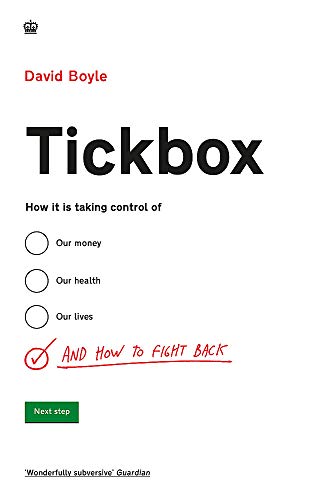



The word 'tickbox' emerged recently as a cynical angle on official or corporate incompetence. They had 'ticked the box' - people said - but failed to act. It is increasingly used to describe this gap between official spin and reality. Yet, says David Boyle in this powerful expose of tickbox culture, that is just the tip of a vast tickbox iceberg. The only people who remain blind to this gap are those rich or powerful enough to run the world, and behind Tickbox lies an insidious philosophy of automation and the misuse of data that weighs heavily on every one of us. It makes our public services less effective - and makes them soar in costs - it lies behind so many stark injustices and disasters, from Grenfell Tower to the deportation of the Windrush generation. Yet the system carries on and grows in power and strengths - vacuuming up the resources of the NHS, pursuing pointless targets or badgering us to reveal how much we had enjoyed our visit to their bank counter - because those who run the world remain committed to it. It is time we escaped the tentacles of Tickbox. Boyle suggests a series of ways out - starting with recognising the danger and calling it out for what it is - a massive failure, corroding our lives and our ability, as human beings, to act on the world.
Author
David Boyle is the author of Blondel’s Song: The Capture, Imprisonment and Ransom of Richard the Lionheart, and a series of books about history, social change and the future. His book Authenticity: Brands, Fakes, Spin and the Lust for Real Life helped put the search for authenticity on the agenda as a social phenomenon. The Tyranny of Numbers and The Sum of Our Discontent predicted the backlash against the government’s target culture. Funny Money launched the time banks movement in the UK. David is an associate of the new economics foundation, the pioneering think-tank in London, and has been at the heart of the effort to introduce time banks to Britain as a critical element of public service reform - since when the movement has grown to more than 100 projects in the UK. He is also the founder of the London Time Bank network and co-founder of Time Banks UK. He writes about the future of volunteering, cities and business. His work on the future of money has also been covered in books and pamphlets like Why London Needs its own Currency (nef, 2000), Virtual Currencies (Financial Times, 2000), The Money Changers: Currency reform from Aristotle to e-cash (Earthscan, 2002) and The Little Money Book (Alastair Sawday, 2003). He has written for many national newspapers and magazines, and edited a range of magazines including Town & Country Planning and Liberal Democrat News. He is the editor of Radical Economics. He lives in Crystal Palace, in south London, with Sarah and Robin (two years old). He is a member of the Federal Policy Committee of the Liberal Democrats and he stood for Parliament in Regents Park and Kensington North in 2001.