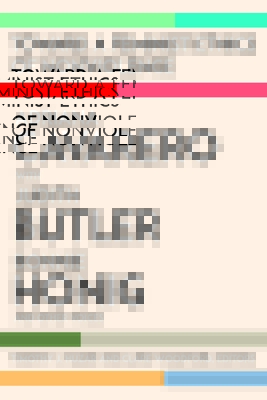



Toward a Feminist Ethics of Nonviolence brings together major feminist thinkers to debate Cavarero's call for a postural ethics of nonviolence and a sociality rooted in bodily interdependence. Toward a Feminist Ethics of Nonviolence brings together three major feminist thinkers—Adriana Cavarero, Judith Butler, and Bonnie Honig—to debate Cavarero's call for a postural ethics of nonviolence. The book consists of three longer essays by Cavarero, Butler, and Honig, followed by shorter responses by a range of scholars that widen the dialogue, drawing on post-Marxism, Italian feminism, queer theory, and lesbian and gay politics. Together, the authors contest the boundaries of their common project for a pluralistic, heterogeneous, but urgent feminist ethics of nonviolence.

Authors
Bonnie Honig is a political and legal theorist specialized in democratic and feminist theory. She is Sarah Rebecca Roland Professor of Political Science at Northwestern University and Senior Research Professor at the American Bar Foundation. She received her PhD from Johns Hopkins University. Prior to moving to Northwestern University, Prof. Honig taught at Harvard University for several years. The 1997 decision by then-President of Harvard Neil Rudenstine not to offer Honig tenure was highly controversial, and attracted harsh criticism from a number of prominent Harvard professors as a violation of Rudenstine's stated commitment to increasing the number of tenured female professors.


Judith Butler is an American post-structuralist and feminist philosopher who has contributed to the fields of feminism, queer theory, political philosophy and ethics. They are currently a professor in the Rhetoric and Comparative Literature departments at the University of California, Berkeley. Butler received their Ph.D. in philosophy from Yale University in 1984, for a dissertation subsequently published as Subjects of Desire: Hegelian Reflections in Twentieth-Century France. In the late-1980s they held several teaching and research appointments, and were involved in "post-structuralist" efforts within Western feminist theory to question the "presuppositional terms" of feminism. Their research ranges from literary theory, modern philosophical fiction, feminist and sexuality studies, to 19th- and 20th-century European literature and philosophy, Kafka and loss, and mourning and war. Their most recent work focuses on Jewish philosophy and exploring pre- and post-Zionist criticisms of state violence.