


Margins
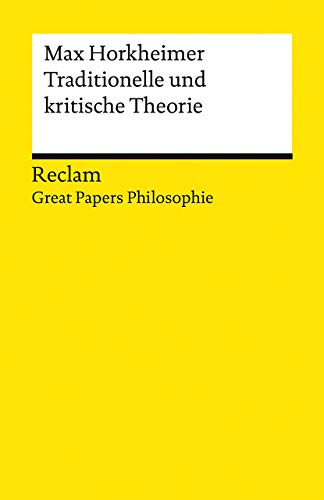
Traditionelle und kritische Theorie book cover
Traditionelle und kritische Theorie
[Great Papers Philosophie]
1937
First Published
3.91
Average Rating
153
Number of Pages

Kritische Theorie soll die Gesellschaft emanzipieren, statt sie wie herkömmliche Forschung nur zu erfen. Die Grundzüge dieser engagierten Wissenschaft skizzierte Horkheimer erstmals in seinem berühmten Aufsatz von 1937 in der Zeitschrift für Sozialforschung . Das Nachwort hilft, die schwierigen Konsequenzen dieser einfachen Idee nachzuvollziehen. Außerdem wird die wichtigste Kritik an Horkheimers Argumenten sowie deren Weiterentwicklung in der Frankfurter Schule aufgezeigt und das Fortleben des so wichtigen, epochemachenden Textes bis heute nachgezeichnet.
Avg Rating
3.91
Number of Ratings
115
5 STARS
31%
4 STARS
43%
3 STARS
17%
2 STARS
3%
1 STARS
5%
goodreads

Author

Max Horkheimer
Max Horkheimer
Author · 6 books
Max Horkheimer (1895–1973) was a leader of the so-called “Frankfurt School,” a group of philosophers and social scientists associated with the Institut für Sozialforschung (Institute of Social Research) in Frankfurt am Main. Horkheimer was the director of the Institute and Professor of Social Philosophy at the University of Frankfurt from 1930–1933, and again from 1949–1958. In between those periods he would lead the Institute in exile, primarily in America. As a philosopher he is best known (especially in the Anglophone world), for his work during the 1940s, including Dialectic of Enlightenment, which was co-authored with Theodor Adorno. While deservedly influential, Dialectic of Enlightenment (and other works from that period) should not be separated from the context of Horkheimer's work as a whole. Especially important in this regard are the writings from the 1930s, which were largely responsible for developing the epistemological and methodological orientation of Frankfurt School critical theory. This work both influenced his contemporaries (including Adorno and Herbert Marcuse) and has had an enduring influence on critical theory's later practitioners (including Jürgen Habermas, and the Institute's current director Axel Honneth).
548 Market St PMB 65688, San Francisco California 94104-5401 USA
© 2026 Paratext Inc. All rights reserved