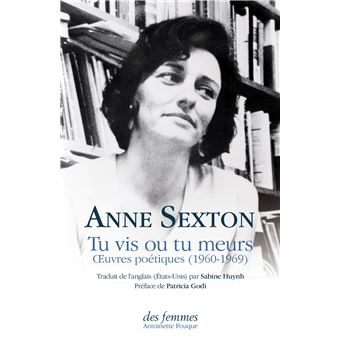



La présente édition réunit les quatre premiers recueils d'Anne Sexton (1928-1977) publiés dans les années soixante, To Bedlam and Part Way Back (1960), All my Pretty Ones (1962), Live or Die (1966) et Love Poems (1969). Icône de la poésie américaine, Anne Sexton est un oiseau rare de l'histoire littéraire étasunienne. Autodidacte, elle mène dans un premier temps une vie conventionnelle d'épouse et de mère. Mais ce cadre se fissure rapidement, elle traverse alors une grave dépression nerveuse assortie de pulsions suicidaires qui la conduisent à l'hôpital psychiatrique, où elle fait une rencontre déterminante. Le docteur Martin Orne, se rendant compte du potentiel de sa jeune patiente, l'encourage à écrire. Son premier recueil, To Bedlam and Part Way Back (Retour partiel de l'asile), la place parmi les figures marquantes du confessionnalisme américain incarné par le poète Robert Lowell. Dans un style novateur et transgressif, d'une troublante beauté, Anne Sexton développe des thèmes absents de la poésie de l'époque, tels que les menstruations, l'avortement, le lien matriciel ou un regard féminin sur l'inceste et la psychanalyse. Durant la prolixe période des années 1960, elle publie des ouvrages reconnus par ses pairs comme des chefs-d'oeuvre, dont Live or Die (Tu vis où tu meurs) récompensé par le prix Pulitzer en 1967. Une longue exégèse littéraire féministe reconnaîtra à son tour tout l'apport de cette immense poétesse. Les oeuvres couvrant la décennie de sa venue à l'écriture paraissent pour la première fois en France, présentées par Patricia Godi, dans la remarquable traduction de Sabine Huynh. "Et nous sommes de la magie se parlant à elle-même, bruyante et solitaire. Je suis la reine de tous mes vices oubliés. Suis-je toujours égarée ? Jadis j'étais belle. Maintenant je suis moi-même, comptant des mocassins rangée après rangée sur l'étagère muette où ils continuent d'espérer."
Author

Anne Sexton once told a journalist that her fans thought she got better, but actually, she just became a poet. These words are characteristic of a talented poet that received therapy for years, but committed suicide in spite of this. The poetry fed her art, but it also imprisoned her in a way. Her parents didn’t expect much of her academically, and after completing her schooling at Rogers Hall, she went to a finishing school in Boston. Anne met her husband, Kayo (Alfred Muller Sexton II), in 1948 by correspondence. Her mother advised her to elope after she thought she might be pregnant. Anne and Kayo got married in 1948 in North Carolina. After the honeymoon Kayo started working at his father-in-law’s wool business. In 1953 Anne gave birth to her first-born, Linda Gray. Two years later Linda’s sister, Joyce Ladd, was born. But Anne couldn’t cope with the pressure of two small children over and above Kayo’s frequent absence (due to work). Shortly after Joy was born, Anne was admitted to Westwood Lodge where she was treated by the psychiatrist Dr. Martha Brunner-Orne (and six months later, her son, Dr. Martin Orne, took over). The original diagnosis was for post-natal depression, but the psychologists later decided that Anne suffered from depression of biological nature. While she was receiving psychiatric treatment, Anne started writing poetry. It all started after another suicide attempt, when Orne came to her and told her that she still has a purpose in life. At that stage she was convinced that she could only become a prostitute. Orne showed her another talent that she had, and her first poetry appeared in print in the January of 1957. She wrote a huge amount of poetry that was published in a dozen poetry books. In 1967 she became the proud recipient of the Pulitzer Prize for Live or Die (1966). In March 1972 Anne and Kayo got divorced. After this a desperate kind of loneliness took over her life. Her addiction to pills and alcohol worsened. Without Kayo the house was very quiet, the children were at college and most of Anne’s friends were avoiding her because they could no longer sympathize with her growing problems. Her poetry started playing such a major role in her life that conflicts were written out, rather than being faced. Anne didn’t mention a word to Kayo about her intention to get divorced. He knew that she desperately needed him, but her poems, and her real feelings toward him, put it differently. Kayo talks about it in an interview as follows: “... I honestly don’t know, never have known, what her real, driving motive was in the divorce. Which is another reason why it absolutely drove me into the floor like a nail when she did it.” On 4 October 1974 she put on her mother’s old fur coat before, glass of vodka in hand, she climbed into her car, turned the key and died of monodioxide inhalation. She once told Orne that “I feel like my mother whenever I put it [the fur coat] on”. Her oldest daughter, Linda, was appointed as literary executor and we have her to thank for the three poetry books that appeared posthumously.