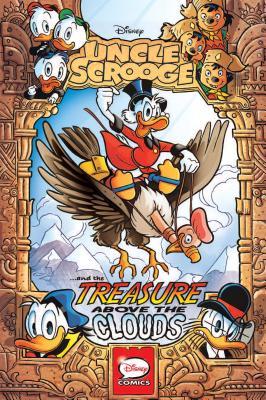



Is Scrooge McDuck always sharper than the sharpies? Find out in these tales from around the world, many never before published in the U.S.! In "Treasure Above the Clouds," Scrooge battles playboy plutocrat John D. Rockerduck for ownership of an awesome Incan treasure! Then, it's Valentine's Day in Duckburg, and Scrooge faces a firestorm from two dastardly dates—Klondike goldminer Glittering Goldie and brassy business-gal Brigitta MacBridge! And in "Money is the Root of Upheaval!," a duck tale by Jerry Siegel (co-creator of Superman), Scrooge McDuck travels through time to find riches in ancient Egypt, only to wind up stranded in a dystopian future! Collects IDW's Uncle Scrooge issues #35-37.
Authors

Carl Barks (March 27, 1901 – August 25, 2000) was an American Disney Studio illustrator and comic book creator, who invented Duckburg and many of its inhabitants, such as Scrooge McDuck (1947), Gladstone Gander (1948), the Beagle Boys (1951), The Junior Woodchucks (1951), Gyro Gearloose (1952), Cornelius Coot (1952), Flintheart Glomgold (1956), John D. Rockerduck (1961) and Magica De Spell (1961). The quality of his scripts and drawings earned him the nicknames "The Duck Man" and "The Good Duck Artist". People who work for Disney generally do so in relative anonymity; the stories only carry Walt Disney's name and (sometimes) a short identification number. Prior to 1960, the creator of these stories remained a mystery to his readers. However, many readers recognized Barks' work and drawing style, and began to call him the Good Duck Artist, a label which stuck even after his true identity was discovered by John and Bill Spicer in 1959. After Barks received a 1960 visit from Bill and John Spicer and Ron Leonard, he was no longer anonymous, as his name soon became known to his readers. Writer-artist Will Eisner called him "the Hans Christian Andersen of comic books." In 1987, Barks was one of the three inaugural inductees of the Will Eisner Comic Book Hall of Fame. (From wikipedia)

Giorgio Fontana è uno scrittore italiano. Cresce a Caronno Pertusella, paese industriale in provincia di Varese, e studia Filosofia all'Università Statale di Milano, laureandosi con una tesi sul realismo interno di Hilary Putnam. Nel 2007 pubblica il romanzo d'esordio Buoni propositi per l'anno nuovo (Mondadori), cui segue Novalis (Marsilio 2008). Con il reportage narrativo sugli immigrati a Milano Babele 56. Otto fermate nella città che cambia (Terre di Mezzo 2008), è finalista al Premio Tondelli 2009. Nel 2011 pubblica per Zona il saggio La velocità del buio. Per legge superiore, uscito a fine ottobre 2011 per Sellerio, ha vinto il Premio Racalmare - Leonardo Sciascia 2012, il Premio lo Straniero 2012 e la XXVI edizione del Premio Chianti. Il libro ha avuto sei ristampe ed è stato tradotto in Francia (Seuil), Germania (Nagel&Kimche) e Olanda (Wereldbibliotheek). Il suo ultimo romanzo, che chiude il dittico su magistratura e giustizia iniziato con Per legge superiore, è Morte di un uomo felice (Sellerio 2014[2]). Il libro è vincitore del Premio Campiello 2014 e del Premio Loria 2014 ed è in corso di traduzione in Francia, Germania e Olanda. Fontana ha pubblicato articoli e saggi su diverse testate, fra cui "il manifesto", "Lo Straniero", Opendemocracy.net, "Il primo amore", Berfrois, "Wired" ecc. Dal 2005 al 2010 è stato condirettore del pamphlet letterario "Eleanore Rigby". Attualmente vive e lavora come content manager a Milano. Collabora con "IL", "TuttoLibri", l'inserto "La Lettura" del Corriere della Sera e altre riviste.