


Margins
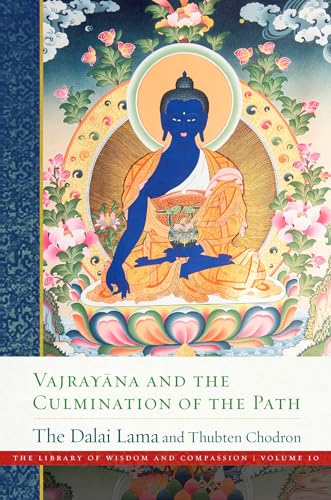
Vajrayana and the Culmination of the Path book cover
Vajrayana and the Culmination of the Path
2024
First Published
5.00
Average Rating
603
Number of Pages

The final volume of the Library of Wisdom and Compassion by His Holiness the Dalai Lama takes us to the uncommon practices and realizations of Vajrayana to the full awakening of a buddha. His Holiness the Dalai Lama skillfully illuminates the unique qualities of Vajrayana, as practiced in Tibet, and the method to eradicate the subtlest obscurations preventing the full awakening of a buddha. Speaking to newcomers and advanced students alike, he explains the similarities and differences of the Sutra and Tantra paths. Having gathered many of the doubts and difficult points concerning the tantric path, he clarifies the purpose of receiving proper empowerment by qualified gurus and the ethical restraints and commitments required to enter the path of secret mantra. The paths and stages of the four tantric classes are explained, as are the generation-stage and completion-stage practices of Highest Yoga Tantra. You are introduced to the practices of clear appearance and divine identity common to all tantric sadhanas, as well as the distinctive practices of illusory body and actual clear light that overcome the subtlest defilements on the mind and eliminate all obscurations quickly. The understanding of emptiness in Sutra and Tantra is the same, but the consciousness perceiving emptiness differs. In Highest Yoga Tantra that consciousness is great bliss, which arises from knowing the methods to manipulate the channels, winds, and drops of the subtle body. In short, in Vajrayana and the Culmination of the Path the Dalai Lama sets out the path that leads to blissful awakening and enables us to be of great benefit to all sentient beings.
Avg Rating
5.00
Number of Ratings
2
5 STARS
100%
4 STARS
0%
3 STARS
0%
2 STARS
0%
1 STARS
0%
goodreads

Authors

Dalai Lama
Dalai Lama
Author · 166 books

Jetsun Jamphel Ngawang Lobsang Yeshe Tenzin Gyatso (born Lhamo Döndrub), the 14th Dalai Lama, is a practicing member of the Gelug School of Tibetan Buddhism and is influential as a Nobel Peace Prize laureate, the world's most famous Buddhist monk, and the leader of the exiled Tibetan government in India. Tenzin Gyatso was the fifth of sixteen children born to a farming family. He was proclaimed the tulku (an Enlightened lama who has consciously decided to take rebirth) of the 13th Dalai Lama at the age of two. On 17 November 1950, at the age of 15, he was enthroned as Tibet's ruler. Thus he became Tibet's most important political ruler just one month after the People's Republic of China's invasion of Tibet on 7 October 1950. In 1954, he went to Beijing to attempt peace talks with Mao Zedong and other leaders of the PRC. These talks ultimately failed. After a failed uprising and the collapse of the Tibetan resistance movement in 1959, the Dalai Lama left for India, where he was active in establishing the Central Tibetan Administration (the Tibetan Government in Exile) and in seeking to preserve Tibetan culture and education among the thousands of refugees who accompanied him. Tenzin Gyatso is a charismatic figure and noted public speaker. This Dalai Lama is the first to travel to the West. There, he has helped to spread Buddhism and to promote the concepts of universal responsibility, secular ethics, and religious harmony. He was awarded the Nobel Peace Prize in 1989, honorary Canadian citizenship in 2006, and the United States Congressional Gold Medal on 17 October 2007.

548 Market St PMB 65688, San Francisco California 94104-5401 USA
© 2026 Paratext Inc. All rights reserved