Bloemlezing uit "Stories they wouldn't let me don on TV" 1 & 2 Alfred Hitchcock fascineert miljoenen door zijn spannede films. De laatste tijd heeft hij ook de televisiekijkers met korte films verrast, die zowel in het buitenland als hier te lande gretig zijn opgenomen. Misschien is er geen regisseur in de wereld die zo'n fijne neus heeft voor het spannende, het adembenemende, en voor de filmuitbeelding daarvan, als Hitchcock. Maar het is te begrijpen, dat hij vele verhalen ontdekte die hij - niettegenstaande zijn enthousiasme - toch niet voor de film en voor de televisie kon gebruiken. Zij waren té subtiel, té grotesk of té griezelig om voor verfilming of televisieuitzending in aanmerking te komen. Toch vond hij ze zó goed, dat hij ze in boekvorm heeft gebundeld en uitgegeven, om de liefhebbers in het genre in de gelegenheid te stellen op deze wijze van zijn keuze te genieten. Het voordeel van deze vorm is, dat men er bij kan nadenken, naar buiten kan kijken en het licht aanlaten. Het laatste is niet van belang ontbloot, want als deze grootmeester van het macabere en het griezelige, verhalen uitkiest, kan men beter het donker mijden. John Russel - De prijs van het hoofd (The price of the head) Q. Patrick - Juffrouw Lucie leert de liefde kennen (Love comes to miss Lucy) 'Saki' (H.H. Munro) - Sredni vashtar (Sredni Vashtar) Philip MacDonald - Liefde ligt te verbloeden (Love lies bleeding) Jerome K. Jerome - De danspartner (The dancing partner) William Hope Hodgson - De stem in de nacht (The voice in the night) Stanley Ellin - Het ogenblik der beslissing (The moment of decision) James Francis Dwyer - Een les in de jungle (A jungle graduate) C.P. Donnel jr. - Moordrecept (Recipe for murder) Roald Dahl - Nunc dimittis (Nunc Dimittis) Richard Connell - Het gevaarlijkste spel (The dangerous game) A.M. Burrage - Het wassenbeeldenspel (The waxwork) Robert Bloch - De ratten kwamen (Water's edge) Robert Arthur - De grappenmaker (The jokester)
Authors

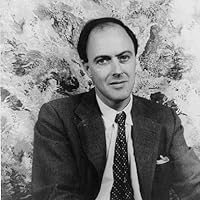
Roald Dahl was a British novelist, short story writer and screenwriter of Norwegian descent, who rose to prominence in the 1940's with works for both children and adults, and became one of the world's bestselling authors. Dahl's first published work, inspired by a meeting with C. S. Forester, was Shot Down Over Libya. Today the story is published as A Piece of Cake. The story, about his wartime adventures, was bought by the Saturday Evening Post for $900, and propelled him into a career as a writer. Its title was inspired by a highly inaccurate and sensationalized article about the crash that blinded him, which claimed he had been shot down instead of simply having to land because of low fuel. His first children's book was The Gremlins, about mischievous little creatures that were part of RAF folklore. The book was commissioned by Walt Disney for a film that was never made, and published in 1943. Dahl went on to create some of the best-loved children's stories of the 20th century, such as Charlie and the Chocolate Factory, Matilda and James and the Giant Peach. He also had a successful parallel career as the writer of macabre adult short stories, usually with a dark sense of humour and a surprise ending. Many were originally written for American magazines such as Ladies Home Journal, Harper's, Playboy and The New Yorker, then subsequently collected by Dahl into anthologies, gaining world-wide acclaim. Dahl wrote more than 60 short stories and they have appeared in numerous collections, some only being published in book form after his death. His stories also brought him three Edgar Awards: in 1954, for the collection Someone Like You; in 1959, for the story "The Landlady"; and in 1980, for the episode of Tales of the Unexpected based on "Skin".

Philip MacDonald (who some give as 1896 or 1899 as his date of birth) was the grandson of the writer George MacDonald and son of the author Ronald MacDonald and the actress Constance Robertson. During World War I he served with the British cavalry in Mesopotamia, later trained horses for the army, and was a show jumper. He also raised Great Danes. After marrying the writer F. Ruth Howard, he moved to Hollywood in 1931. He was one of the most popular mystery writers of the 1930s, and between 1931 and 1963 wrote many screenplays along with a few radio and television scripts. His detective novels, particularly those featuring his series detective Anthony Gethryn, are primarily "whodunnits" with the occasional locked room mystery. His first detective novel was 'The Rasp' (1924), in which he introduced his character Anthony Gethryn. In later years MacDonald wrote television scripts for Alfred Hitchcock Presents ('Malice Domestic', 1957) and Perry Mason ('The Case of the Terrified Typist', 1958). He twice received an Edgar Award for Best Short Story: in 1953, for 'Something to Hide', and in 1956, for 'Dream No More'. Indeed many critics felt that his short story writing was superior to his novels and they did win five second prizes in the annual contests held by 'Ellery Queen's Mystery Magazine'. He also wrote under the pseudonyms Oliver Fleming, Anthony Lawless, Martin Porlock, W.J. Stuart and Warren Stuart.
Alfred McLelland Burrage (1889-1956) was a British writer. He was noted in his time as an author of fiction for boys which he published under the pseudonym Frank Lelland, including a popular series called "Tufty". Burrage is now remembered mainly for his horror fiction. Source: Wikipedia


Known British writer Hector Hugh Munro under pen name Saki published his witty and sometimes bitter short stories in collections, such as The Chronicles of Clovis (1911). His sometimes macabre satirized Edwardian society and culture. People consider him a master and often compare him to William Sydney Porter and Dorothy Rothschild Parker. His tales feature delicately drawn characters and finely judged narratives. "The Open Window," perhaps his most famous, closes with the line, "Romance at short notice was her specialty," which thus entered the lexicon. Newspapers first and then several volumes published him as the custom of the time. His works include * a full-length play, The Watched Pot , in collaboration with Charles Maude; * two one-act plays; * a historical study, The Rise of the Russian Empire , the only book under his own name; * a short novel, The Unbearable Bassington ; * the episodic The Westminster Alice , a parliamentary parody of Alice in Wonderland ; * and When William Came: A Story of London under the Hohenzollerns , an early alternate history. Oscar Fingal O'Flahertie Wills Wilde, Charles Lutwidge Dodgson, and Joseph Rudyard Kipling, influenced Munro, who in turn influenced Alan Alexander Milne, Sir Noel Pierce Coward, and Pelham Grenville Wodehouse.

English author Jerome Klapka Jerome, best known for the humorous travelogue Three Men in a Boat . See http://en.wikipedia.org/wiki/Jerome\_K...