Margins
Margins
Sign in
Margins
Subscribe to our newsletter
548 Market St PMB 65688, San Francisco California 94104-5401 USA
hello@margins.app
·
+1 (650) 223-5283
Privacy Policy
·
Terms of Use
© 2026 Paratext Inc. All rights reserved
📚 Vonnegut Classics
📚
Vonnegut Classics
Desayuno de campeones
1973
Kurt Vonnegut
Alternate cover for this ISBN can be found here In Breakfast of Champions, one of Kurt Vonnegut’s most beloved characters, the aging writer Kilgore Trout, finds to his horror that a Midwest car dealer is taking his fiction as truth. What follows is murderously funny satire, as Vonnegut looks at war, sex, racism, success, politics, and pollution in America and reminds us how to see the truth.
Mother Night
1961
Kurt Vonnegut
Librarian note: Alternate cover edition for this ISBN can be found here. Mother Night is a daring challenge to our moral sense. American Howard W. Campbell, Jr., a spy during World War II, is now on trial in Israel as a Nazi war criminal. But is he really guilty? In this brilliant book rife with true gallows humor, Vonnegut turns black and white into a chilling shade of gray with a verdict that will haunt us all.
Deadeye Dick
1982
Kurt Vonnegut
Deadeye Dick is Kurt Vonnegut’s funny, chillingly satirical look at the death of innocence. Amid a true Vonnegutian host of horrors—a double murder, a fatal dose of radioactivity, a decapitation, an annihilation of a city by a neutron bomb—Rudy Waltz, aka Deadeye Dick, takes us along on a zany search for absolution and happiness. Here is a tale of crime and punishment that makes us rethink what we believe . . . and who we say we are.
Slapstick, or Lonesome No More!
1976
Kurt Vonnegut
Slapstick presents an apocalyptic vision as seen through the eyes of the current King of Manhattan (and last President of the United States), a wickedly irreverent look at the all-too-possible results of today’s follies. But even the end of life-as-we-know-it is transformed by Kurt Vonnegut’s pen into hilarious farce—a final slapstick that may be the Almighty’s joke on us all.
Cat's Cradle
1963
Kurt Vonnegut
Told with deadpan humour and bitter irony, Kurt Vonnegut's cult tale of global destruction preys on our deepest fears of witnessing Armageddon and, worse still, surviving it ... Dr Felix Hoenikker, one of the founding 'fathers' of the atomic bomb, has left a deadly legacy to the world. For he's the inventor of 'ice-nine', a lethal chemical capable of freezing the entire planet. The search for its whereabouts leads to Hoenikker's three ecentric children, to a crazed dictator in the Caribbean, to madness. Felix Hoenikker's Death Wish comes true when his last, fatal gift to humankind brings about the end, that for all of us, is nigh...
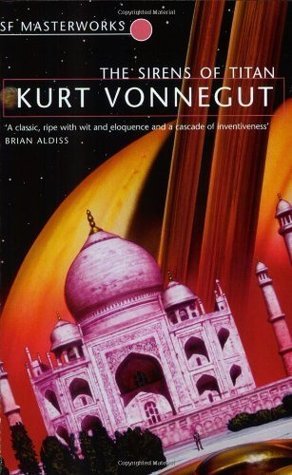
The Sirens of Titan
1959
Kurt Vonnegut
The Sirens of Titan is an outrageous romp through space, time, and morality. The richest, most depraved man on Earth, Malachi Constant, is offered a chance to take a space journey to distant worlds with a beautiful woman at his side. Of course there's a catch to the invitation—and a prophetic vision about the purpose of human life that only Vonnegut has the courage to tell.
Slaughterhouse-Five
1969
Kurt Vonnegut
Selected by the Modern Library as one of the 100 best novels of all time, Slaughterhouse-Five, an American classic, is one of the world's great antiwar books. Centering on the infamous firebombing of Dresden, Billy Pilgrim's odyssey through time reflects the mythic journey of our own fractured lives as we search for meaning in what we fear most.
God Bless You, Mr. Rosewater
1965
Kurt Vonnegut
Second only to Slaughterhouse-Five of Vonnegut's canon in its prominence and influence, God Bless You, Mr. Rosewater (1965) presents Eliot Rosewater, an itinerant, semi-crazed millionaire wandering the country in search of heritage and philanthropic outcome, introducing the science fiction writer Kilgore Trout to the world and Vonnegut to the collegiate audience which would soon make him a cult writer. Trout, modeled according to Vonnegut on the science fiction writer Theodore Sturgeon (with whom Vonnegut had an occasional relationship) is a desperate, impoverished but visionary hack writer who functions for Eliot Rosewater as both conscience and horrid example. Rosewater, seeking to put his inheritance to some meaningful use (his father was an entrepreneur), tries to do good within the context of almost illimitable cynicism and corruption. It is in this novel that Rosewater wanders into a science fiction conference—an actual annual event in Milford, Pennsylvania—and at the motel delivers his famous monologue evoked by science fiction writers and critics for almost half a century: "None of you can write for sour apples... but you're the only people trying to come to terms with the really terrific things which are happening today." Money does not drive Mr. Rosewater (or the corrupt lawyer who tries to shape the Rosewater fortune) so much as outrage at the human condition. The novel was adapted for a 1979 Alan Menken musical. The novel is told mostly thru a collection of short stories dealing with Eliot's interactions with the citizens of Rosewater County, usually with the last sentence serving as a punch line. The antagonist's tale, Mushari's, is told in a similar short essay fashion. The stories reveal different hypocrisies of humankind in a darkly humorous fashion.
Player Piano
1952
Kurt Vonnegut
Kurt Vonnegut’s first novel spins the chilling tale of engineer Paul Proteus, who must find a way to live in a world dominated by a supercomputer and run completely by machines. Paul’s rebellion is vintage Vonnegut—wildly funny, deadly serious, and terrifyingly close to reality. Alternate cover edition here