Margins
Margins
Sign in
Margins
Subscribe to our newsletter
548 Market St PMB 65688, San Francisco California 94104-5401 USA
hello@margins.app
·
+1 (650) 223-5283
Privacy Policy
·
Terms of Use
© 2026 Paratext Inc. All rights reserved
👹 WANT
👹
WANT
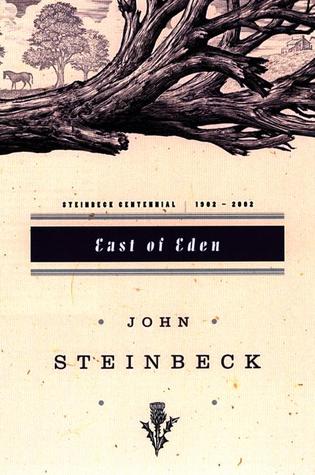
East of Eden
1952
John Steinbeck
In his journal, Nobel Prize winner John Steinbeck called East of Eden “the first book,” and indeed it has the primordial power and simplicity of myth. Set in the rich farmland of California’s Salinas Valley, this sprawling and often brutal novel follows the intertwined destinies of two families—the Trasks and the Hamiltons—whose generations helplessly reenact the fall of Adam and Eve and the poisonous rivalry of Cain and Abel. Adam Trask came to California from the East to farm and raise his family on the new rich land. But the birth of his twins, Cal and Aaron, brings his wife to the brink of madness, and Adam is left alone to raise his boys to manhood. One boy thrives nurtured by the love of all those around him; the other grows up in loneliness enveloped by a mysterious darkness. First published in 1952, East of Eden is the work in which Steinbeck created his most mesmerizing characters and explored his most enduring themes: the mystery of identity, the inexplicability of love, and the murderous consequences of love's absence. A masterpiece of Steinbeck's later years, East of Eden is a powerful and vastly ambitious novel that is at once a family saga and a modern retelling of the Book of Genesis.
La Faute de l'abbé Mouret
1875
Emile Zola
The Sin of Abbé Mouret tells the compelling story of the young priest Serge Mouret. Striving after spiritual purity and sanctity, he lives a life of constant prayer, but his neglect of all physical needs leads to serious illness, followed by amnesia. No longer knowing he is a priest, he falls in love with his nurse Albine. Together, like a latter-day Adam and Eve, they roam through an Eden-like garden called the 'Paradou', seeking a forbidden tree in whose shade they will make love. Zola memorably shows their gradual awakening to sexuality, and his poetic descriptions of the luxuriant and beautiful Paradou create a lyrical celebration of Nature. When Serge regains his memory and recalls his priestly vows, anguish inevitably follows. The whole story, with its numerous biblical parallels, becomes a poetic reworking of the Fall of Man and a questioning of the very meaning of innocence and sin. Zola explores the conflict between Church and Nature, the sterility of the Church and the fertility of Nature. This new translation includes a wide-ranging and helpful introduction and explanatory notes.
The Post-Office Girl
1982
Stefan Zweig
The post-office girl is Christine, who looks after her ailing mother and toils in a provincial Austrian post office in the years just after the Great War. One afternoon, as she is dozing among the official forms and stamps, a telegraph arrives addressed to her. It is from her rich aunt, who lives in America and writes requesting that Christine join her and her husband in a Swiss Alpine resort. After a dizzying train ride, Christine finds herself at the top of the world, enjoying a life of privilege that she had never imagined. But Christine’s aunt drops her as abruptly as she picked her up, and soon the young woman is back at the provincial post office, consumed with disappointment and bitterness. Then she meets Ferdinand, a wounded but eloquent war veteran who is able to give voice to the disaffection of his generation. Christine’s and Ferdinand’s lives spiral downward, before Ferdinand comes up with a plan which will be either their salvation or their doom. Never before published in English, this extraordinary book is an unexpected and haunting foray into noir fiction by one of the masters of the psychological novel.