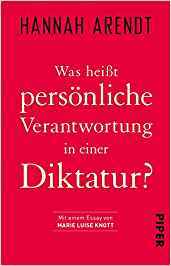
Was heißt persönliche Verantwortung in einer Diktatur?
2018
First Published
4.38
Average Rating
96
Number of Pages
Wie handelt man richtig, wenn das moralische "Richtig" dem gesetzlichen "Richtig" widerspricht? Wie reagiert man auf Missachtungen der Menschenrechte durch höchste Regierungsinstanzen? Wie können wir urteilen über die, in deren Haut wir nicht stecken? Mit diesen Fragen, die Hannah Arendt bereits vor über 50 Jahren beschäftigten, werden wir heute wieder verstärkt konfrontiert. Damals wie heute gilt: Persönliche Verantwortung muss sich von politischer Verantwortung unterscheiden. In Arendts klarer und bestechender Sprache gibt dieser wiederentdeckte Aufsatz Antworten auf die häufigsten Fragen unserer Zeit.
Avg Rating
4.38
Number of Ratings
228
5 STARS
49%
4 STARS
41%
3 STARS
11%
2 STARS
0%
1 STARS
0%
goodreads
Author
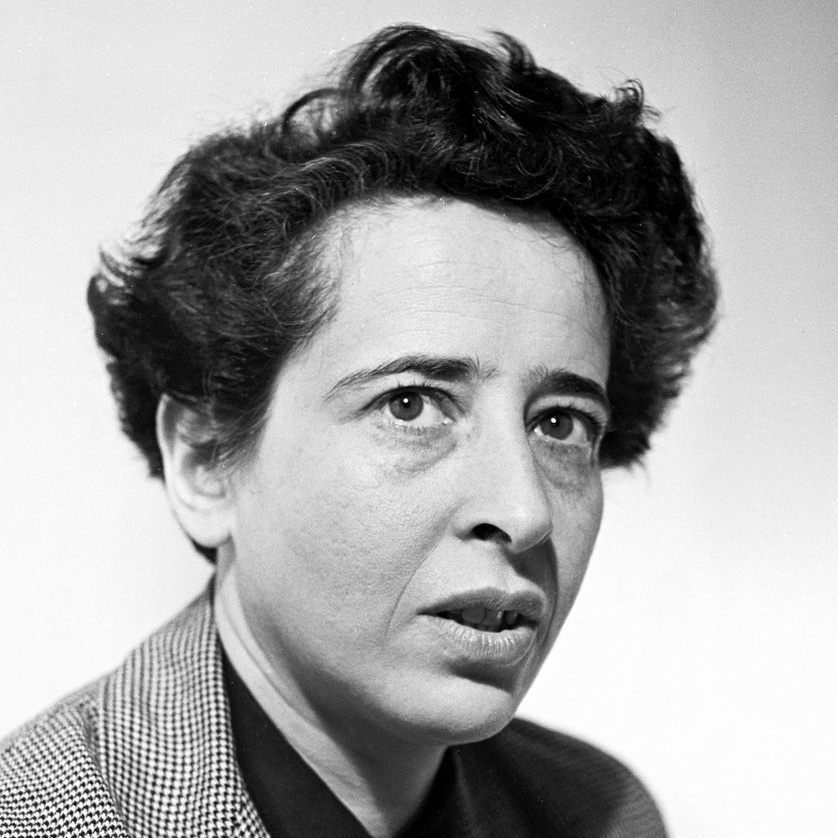
Hannah Arendt
Author · 72 books
Hannah Arendt (1906 – 1975) was one of the most influential political philosophers of the twentieth century. Born into a German-Jewish family, she was forced to leave Germany in 1933 and lived in Paris for the next eight years, working for a number of Jewish refugee organisations. In 1941 she immigrated to the United States and soon became part of a lively intellectual circle in New York. She held a number of academic positions at various American universities until her death in 1975. She is best known for two works that had a major impact both within and outside the academic community. The first, The Origins of Totalitarianism, published in 1951, was a study of the Nazi and Stalinist regimes that generated a wide-ranging debate on the nature and historical antecedents of the totalitarian phenomenon. The second, The Human Condition, published in 1958, was an original philosophical study that investigated the fundamental categories of the vita activa (labor, work, action). In addition to these two important works, Arendt published a number of influential essays on topics such as the nature of revolution, freedom, authority, tradition and the modern age. At the time of her death in 1975, she had completed the first two volumes of her last major philosophical work, The Life of the Mind, which examined the three fundamental faculties of the vita contemplativa (thinking, willing, judging).