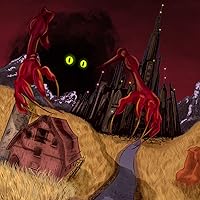
With stories from modern writers, and the founding fathers of horror fiction, weird or cosmic horror combines the dark brooding shadows of the night with the presence of elder gods at the edges of our world. Algernon Blackwood, M.R. James, H.P. Lovecraft and Ramsey Campbell sit alongside new tales by new writers from open submissions. New, contemporary and notable writers featured are: Ramsey Campbell, Daniel Carpenter, Micah Castle, Kevin M. Folliard, Anastasia Garcia, Timothy Granville, Steve Hanson, Maria Haskins, Nyx Kain, Shona Kinsella, Lena Ng, Reggie Oliver, Jason Parent, Bonnie Quinn, Eric Reitan, Cody Schroeder, Lucy A. Snyder, Richard Thomas, Chris Wheatley, and Maria Wolfe. These appear alongside classic stories by Louisa May Alcott, Robert Bloch, William Hope Hodgson, Fritz Leiber, Clark Ashton Smith and more. Contents: - Foreword by Mike Ashley - Lost in a Pyramid by Louisa May Alcott - The Striding Place by Gertrude Atherton - Negotium Perambulans by E.F. Benson - The Willows by Algernon Blackwood - The Secret in the Tomb by Robert Bloch - The Place of Revelation by Ramsey Campbell - Flotsam by Daniel Carpenter - The Things from the Woods by Micah Castle - The Mask by Robert W. Chambers - The New Mother by Lucy Clifford - The Terror of Blue John Gap by Arthur Conan Doyle - The Next Heir by H.D. Everett - The Distortion out fo Space by Francis Flagg - White Noise by Kevin M. Folliard - Dark Skies by Anastasia Garcia - The Crimson Weaver by R. Murray Gilchrist - The Animal King by Timothy Granville - Isle of the Dead by Steve Hanson - The Brightest Lights of Heaven by Maria Haskins - Rappaccini's Daughter by Nathaniel Hawthorne - The Hog by William Hope Hodgson - Mive by Carl Jacobi - The Diary of Mr. Poynter by M.R. James - He Led by Nyx Kain - The Call of El Tunche by Shona Kinsella - The Hill and the Hole by Fritz Leiber - The Whisperer in Darkness by H.P. Lovecraft - Novel of the White Powder by Arthur Machen - Lola by Lena Ng - The Black Ship by Reggie Oliver - The Moon-Slave by Barry Pain - Agon by Jason Parent - The Facts in the Case of M. Valdemar by Edgar Allan Poe - The Stones Move at Night by Bonnie Quinn - The Blessed Affliction by Eric Reitan - Stray by Cody Schroeder - The House of Sounds by M.P. Shiel - The Vaults of Yoh-Vombis by Clark Ashton Smith - While the Black Stars Burn by Lucy A. Snyder - The Moonstone Mass by Harriet Prescott Spofford - From Within by Richard Thomas - The Story of the Late Mr. Elvesham by H.G. Wells - Eternal Visions by Chris Wheatley - Exogenous Cephalus Syndrome: A Case Report and Review of the Literature by Maria Wolfe Flame Tree Gothic & Fantasy, as well as Classic Stories and Epic Tales collections, bring together the entire range of myth, folklore, epic literature and modern short fiction. Highlighting the roots of suspense, supernatural, science fiction and mystery stories, the books in Flame Tree Collections series are beautifully presented, perfect as a gift and offer a lifetime of reading pleasure.
Authors

Robert William Chambers was an American artist and writer. Chambers was first educated at the Brooklyn Polytechnic Institute,and then entered the Art Students' League at around the age of twenty, where the artist Charles Dana Gibson was his fellow student. Chambers studied at the École des Beaux-Arts, and at Académie Julian, in Paris from 1886 to 1893, and his work was displayed at the Salon as early as 1889. On his return to New York, he succeeded in selling his illustrations to Life, Truth, and Vogue magazines. Then, for reasons unclear, he devoted his time to writing, producing his first novel, In the Quarter (written in 1887 in Munich). His most famous, and perhaps most meritorious, effort is The King in Yellow, a collection of weird short stories, connected by the theme of the fictitious drama The King in Yellow, which drives those who read it insane. Chambers returned to the weird genre in his later short story collections The Maker of Moons and The Tree of Heaven, but neither earned him such success as The King in Yellow. Chambers later turned to writing romantic fiction to earn a living. According to some estimates, Chambers was one of the most successful literary careers of his period, his later novels selling well and a handful achieving best-seller status. Many of his works were also serialized in magazines. After 1924 he devoted himself solely to writing historical fiction. Chambers for several years made Broadalbin his summer home. Some of his novels touch upon colonial life in Broadalbin and Johnstown. On July 12, 1898, he married Elsa Vaughn Moller (1882-1939). They had a son, Robert Edward Stuart Chambers (later calling himself Robert Husted Chambers) who also gained some fame as an author. Chambers died at his home in the village of Broadalbin, New York, on December 16th 1933.

Librarian Note: There is more than one author in the Goodreads database with this name. Carl Richard Jacobi was born in Minneapolis, Minnesota in 1904 and lived there throughout his life. He attended the University of Minnesota from 1927 to 1930 where he began his writing career in campus magazines. His first stories were published while he was at the University. The last of these, "Moss Island", was a graduate's contribution to The Quest of Central High School, and "Mive" in the University of Minnesota's The Minnesota Quarterly. Both stories were later sold to Amazing Stories and Weird Tales respectively and marked his debut in professional magazines. "Mive" brought him payment of 25 dollars. He joined the editorial staff of The Minnesota Quarterly, and after graduation in 1931, he became a news reporter for the Minneapolis Star, as well as a frequent reviewer of books and plays. He also served on the staff of the Minnesota Ski-U-Mah, a scholastic publication. After years with the Minneapolis Star, he was the editor for two years of Midwest Media, an advertising and radio trade journal. Later, he devoted himself full-time to writing. He owned his own private retreat, a cabin at Minnewashta in the Carver country outlands of Minneapolis. His intimate familiarity with the terrain and environment there provided the setting for many of his most distinguished stories. Jacobi was a lifelong bachelor. He wrote scores of tales for all the best known magazines of fantasy and science fiction and was represented in numerous anthologies of imaginative fiction published in the United States, England and New Zealand. His stories were translated into French, Swedish, Danish and Dutch. Many of his tales were published in anthologies edited by Derleth, and Arkham House published his first three short story collections. Stories also appeared in such magazines as Short Stories, Railroad Magazine, The Toronto Star, Wonder Stories, MacLean's magazine, Ghost Stories, Strange Stories, Thrilling Mystery, Startling Stories, Complete Stories, Top-Notch and others. Though best known for his macabre fiction, Jacobi also wrote science fiction, weird-menace yarns and adventure stories. From Wikipedia

Harriet Elizabeth Prescott Spofford (April 3, 1835 – August 14, 1921) was a notable American writer remembered for her novels, poems and detective stories. Born in Calais, Maine, in 1835 Spofford moved with her parents to Newburyport, Massachusetts, which was ever after her home, though she spent many of her winters in Boston and Washington, D.C. She attended the Putnam Free School in Newburyport, and Pinkerton Academy in Derry, New Hampshire from 1853 to 1855. At Newburyport her prize essay on Hamlet drew the attention of Thomas Wentworth Higginson, who soon became her friend, and gave her counsel and encouragement. Spofford began writing after her parents became sick, sometimes working fifteen hours a day. She contributed story papers for small pay to Boston. In 1859, she sent a story about Parisian life entitled "In a Cellar" to Atlantic Monthly. The magazine's editor, James Russell Lowell, at first believed the story to be a translation and withheld it from publication. Reassured that it was original, he published it and it established her reputation. She became a welcome contributor to the chief periodicals of the United States, both of prose and poetry. Spofford's fiction had very little in common with what was regarded as representative of the New England mind. Her gothic romances were set apart by luxuriant descriptions, and an unconventional handling of female stereotypes of the day. Her writing was ideal, intense in feeling. In her descriptions and fancies, she reveled in sensuous delights and every variety of splendor.[citation needed] In 1865, she married Richard S. Spofford, a Boston lawyer. They lived on Deer Island overlooking the Merrimack River at Amesbury, where she died on August 14, 1921. When Higginson asked Emily Dickinson whether she had read Spofford's work "Circumstance", Dickinson replied, "I read Miss Prescott's 'Circumstance,' but it followed me in the dark, so I avoided her."

Herbert George Wells was born to a working class family in Kent, England. Young Wells received a spotty education, interrupted by several illnesses and family difficulties, and became a draper's apprentice as a teenager. The headmaster of Midhurst Grammar School, where he had spent a year, arranged for him to return as an "usher," or student teacher. Wells earned a government scholarship in 1884, to study biology under Thomas Henry Huxley at the Normal School of Science. Wells earned his bachelor of science and doctor of science degrees at the University of London. After marrying his cousin, Isabel, Wells began to supplement his teaching salary with short stories and freelance articles, then books, including The Time Machine (1895), The Island of Dr. Moreau (1896), The Invisible Man (1897), and The War of the Worlds (1898). Wells created a mild scandal when he divorced his cousin to marry one of his best students, Amy Catherine Robbins. Although his second marriage was lasting and produced two sons, Wells was an unabashed advocate of free (as opposed to "indiscriminate") love. He continued to openly have extra-marital liaisons, most famously with Margaret Sanger, and a ten-year relationship with the author Rebecca West, who had one of his two out-of-wedlock children. A one-time member of the Fabian Society, Wells sought active change. His 100 books included many novels, as well as nonfiction, such as A Modern Utopia (1905), The Outline of History (1920), A Short History of the World (1922), The Shape of Things to Come (1933), and The Work, Wealth and Happiness of Mankind (1932). One of his booklets was Crux Ansata, An Indictment of the Roman Catholic Church. Although Wells toyed briefly with the idea of a "divine will" in his book, God the Invisible King (1917), it was a temporary aberration. Wells used his international fame to promote his favorite causes, including the prevention of war, and was received by government officials around the world. He is best-remembered as an early writer of science fiction and futurism. He was also an outspoken socialist. Wells and Jules Verne are each sometimes referred to as "The Fathers of Science Fiction". D. 1946. More: http://philosopedia.org/index.php/H.\_... http://www.online-literature.com/well... http://www.hgwellsusa.50megs.com/ http://www.britannica.com/EBchecked/t... http://en.wikipedia.org/wiki/H.\_G.\_Wells

Gertrude Franklin Horn Atherton (October 30, 1857 – June 14, 1948) was a prominent and prolific American author. Many of her novels are set in her home state of California. Her bestseller Black Oxen (1923) was made into a silent movie of the same name. In addition to novels, she wrote short stories, essays, and articles for magazines and newspapers on such issues as feminism, politics, and war. She was strong-willed, independent-minded, and sometimes controversial. She wrote using the pen names Asmodeus and Frank Lin, a play on her middle name.

Sir Arthur Ignatius Conan Doyle was born the third of ten siblings on 22 May 1859 in Edinburgh, Scotland. His father, Charles Altamont Doyle, a talented illustrator, was born in England of Irish descent, and his mother, born Mary Foley, was Irish. They were married in 1855. Although he is now referred to as "Conan Doyle", the origin of this compound surname (if that is how he meant it to be understood) is uncertain. His baptism record in the registry of St Mary's Cathedral in Edinburgh gives 'Arthur Ignatius Conan' as his Christian name, and simply 'Doyle' as his surname. It also names Michael Conan as his godfather. At the age of nine Conan Doyle was sent to the Roman Catholic Jesuit preparatory school, Hodder Place, Stonyhurst. He then went on to Stonyhurst College, leaving in 1875. From 1876 to 1881 he studied medicine at the University of Edinburgh. This required that he provide periodic medical assistance in the towns of Aston (now a district of Birmingham) and Sheffield. While studying, Conan Doyle began writing short stories. His first published story appeared in "Chambers' Edinburgh Journal" before he was 20. Following his graduation, he was employed as a ship's doctor on the SS Mayumba during a voyage to the West African coast. He completed his doctorate on the subject of tabes dorsalis in 1885. In 1885 Conan Doyle married Louisa (or Louise) Hawkins, known as "Touie". She suffered from tuberculosis and died on 4 July 1906. The following year he married Jean Elizabeth Leckie, whom he had first met and fallen in love with in 1897. Due to his sense of loyalty he had maintained a purely platonic relationship with Jean while his first wife was alive. Jean died in London on 27 June 1940. Conan Doyle fathered five children. Two with his first wife—Mary Louise (28 January 1889 – 12 June 1976), and Arthur Alleyne Kingsley, known as Kingsley (15 November 1892 – 28 October 1918). With his second wife he had three children—Denis Percy Stewart (17 March 1909 – 9 March 1955), second husband in 1936 of Georgian Princess Nina Mdivani (circa 1910 – 19 February 1987; former sister-in-law of Barbara Hutton); Adrian Malcolm (19 November 1910–3 June 1970) and Jean Lena Annette (21 December 1912–18 November 1997). Conan Doyle was found clutching his chest in the hall of Windlesham, his house in Crowborough, East Sussex, on 7 July 1930. He had died of a heart attack at age 71. His last words were directed toward his wife: "You are wonderful." The epitaph on his gravestone in the churchyard at Minstead in the New Forest, Hampshire, reads: STEEL TRUE BLADE STRAIGHT ARTHUR CONAN DOYLE KNIGHT PATRIOT, PHYSICIAN & MAN OF LETTERS Conan Doyle's house, Undershaw, located in Hindhead, south of London, where he had lived for a decade, had been a hotel and restaurant between 1924 and 2004. It now stands empty while conservationists and Conan Doyle fans fight to preserve it. A statue honours Conan Doyle at Crowborough Cross in Crowborough, where Conan Doyle lived for 23 years. There is also a statue of Sherlock Holmes in Picardy Place, Edinburgh, close to the house where Conan Doyle was born. Series: * Sherlock Holmes

Fritz Reuter Leiber Jr. was one of the more interesting of the young writers who came into HP Lovecraft's orbit, and some of his best early short fiction is horror rather than sf or fantasy. He found his mature voice early in the first of the sword-and-sorcery adventures featuring the large sensitive barbarian Fafhrd and the small street-smart-ish Gray Mouser; he returned to this series at various points in his career, using it sometimes for farce and sometimes for gloomy mood pieces—The Swords of Lankhmar is perhaps the best single volume of their adventures. Leiber's science fiction includes the planet-smashing The Wanderer in which a large cast mostly survive flood, fire, and the sexual attentions of feline aliens, and the satirical A Spectre is Haunting Texas in which a gangling, exo-skeleton-clad actor from the Moon leads a revolution and finds his true love. Leiber's late short fiction, and the fine horror novel Our Lady of Darkness, combine autobiographical issues like his struggle with depression and alcoholism with meditations on the emotional content of the fantastic genres. Leiber's capacity for endless self-reinvention and productive self-examination kept him, until his death, one of the most modern of his sf generation. Used These Alternate Names: Maurice Breçon, Fric Lajber, Fritz Leiber, Jr., Fritz R. Leiber, Fritz Leiber Jun., Фриц Лейбер, F. Lieber, フリッツ・ライバー

Nathaniel Hawthorne was a 19th century American novelist and short story writer. He is seen as a key figure in the development of American literature for his tales of the nation's colonial history. Shortly after graduating from Bowdoin College, Hathorne changed his name to Hawthorne. Hawthorne anonymously published his first work, a novel titled Fanshawe, in 1828. In 1837, he published Twice-Told Tales and became engaged to painter and illustrator Sophia Peabody the next year. He worked at a Custom House and joined a Transcendentalist Utopian community, before marrying Peabody in 1842. The couple moved to The Old Manse in Concord, Massachusetts, later moving to Salem, the Berkshires, then to The Wayside in Concord. The Scarlet Letter was published in 1850, followed by a succession of other novels. A political appointment took Hawthorne and family to Europe before returning to The Wayside in 1860. Hawthorne died on May 19, 1864, leaving behind his wife and their three children. Much of Hawthorne's writing centers around New England and many feature moral allegories with a Puritan inspiration. His work is considered part of the Romantic movement and includes novels, short stories, and a biography of his friend, the United States President Franklin Pierce.


Kevin M. Folliard is a Chicagoland fiction writer with a degree in English and creative writing from the University of Illinois in Urbana Champaign. His published fiction includes scary stories collections Christmas Terror Tales and Valentine Terror Tales, and adventure novels such as Matt Palmer and the Komodo Uprising and Jimmy Chimaera & the Temple of Champions. Folliard's work has been collected by Sanitarium Magazine, Nosetouch Press, Black Bed Sheet Books, Double Feature Magazine, Flame Tree Publishing, and more. He has also developed films for Neon Harbor, including the video game parody Press Start.


Edward Frederic "E. F." Benson was an English novelist, biographer, memoirist, archaeologist and short story writer. E. F. Benson was the younger brother of A.C. Benson, who wrote the words to "Land of Hope and Glory", Robert Hugh Benson, author of several novels and Roman Catholic apologetic works, and Margaret Benson, an author and amateur Egyptologist. Benson died during 1940 of throat cancer at the University College Hospital, London. He is buried in the cemetery at Rye, East Sussex. Last paragraph from Wikipedia

Howard Phillips Lovecraft, of Providence, Rhode Island, was an American author of horror, fantasy and science fiction. Lovecraft's major inspiration and invention was cosmic horror: life is incomprehensible to human minds and the universe is fundamentally alien. Those who genuinely reason, like his protagonists, gamble with sanity. Lovecraft has developed a cult following for his Cthulhu Mythos, a series of loosely interconnected fictions featuring a pantheon of human-nullifying entities, as well as the Necronomicon, a fictional grimoire of magical rites and forbidden lore. His works were deeply pessimistic and cynical, challenging the values of the Enlightenment, Romanticism and Christianity. Lovecraft's protagonists usually achieve the mirror-opposite of traditional gnosis and mysticism by momentarily glimpsing the horror of ultimate reality. Although Lovecraft's readership was limited during his life, his reputation has grown over the decades. He is now commonly regarded as one of the most influential horror writers of the 20th Century, exerting widespread and indirect influence, and frequently compared to Edgar Allan Poe. — Wikipedia


Robert Murray Gilchrist was born in Sheffield, England in 1867. He never married and throughout his life lived mostly in remote places, including the North Derbyshire village of Holmesfield and a remote part of the Peak District. He began his writing career in 1890 with a novel, Passion the Plaything, and would go on to publish a total of 22 novels, six story collections, four regional interest books, and a play. His stories appeared in many popular periodicals of that era, including The Temple Bar and the decadent journal The Yellow Book. Not much is known about Gilchrist’s personal life, but he is known to have lived for a time with a male companion, and given that Gilchrist never married and sometimes featured homoerotic themes in his work, as in the story ‘My Friend’, it is possible he was homosexual. Though well known today to connoisseurs of weird and Decadent fiction, Gilchrist’s story collection The Stone Dragon and Other Tragic Romances was generally poorly received by critics on its initial appearance in 1894, and following the book’s failure, Gilchrist chose to write in other genres. It was not until Hugh Lamb began anthologizing some of Gilchrist’s work in the 1970s that he began to be rediscovered. Now he is ranked by many alongside other fin de siècle practitioners of weird fiction, including Vernon Lee, Arthur Machen, and Eric Stenbock and The Stone Dragon is a volume highly sought-after by collectors. During World War I, Gilchrist was noted for his charitable assistance to Belgian refugees, many of whom attended his funeral after his death in 1917. -Valancourt Books

People best know American writer Louisa May Alcott for Little Women (1868), her largely autobiographical novel. As A.M. Barnard: Behind a Mask, or a Woman's Power (1866) The Abbot's Ghost, or Maurice Treherne's Temptation (1867) A Long Fatal Love Chase (1866 – first published 1995) First published anonymously: A Modern Mephistopheles (1877) Philosopher-teacher Amos Bronson Alcott, educated his four daughters, Anna, Louisa, Elizabeth and May and Abigail May, wife of Amos, reared them on her practical Christianity. Louisa spent her childhood in Boston and Concord, Massachusetts, where visits to library of Ralph Waldo Emerson, excursions into nature with Henry David Thoreau, and theatricals in the barn at Hillside (now "Wayside") of Nathaniel Hawthorne enlightened her days. Like Jo March, her character in Little Women, young Louisa, a tomboy, claimed: "No boy could be my friend till I had beaten him in a race, ... and no girl if she refused to climb trees, leap fences...." Louisa wrote early with a passion. She and her sisters often acted out her melodramatic stories of her rich imagination for friends. Louisa preferred to play the "lurid" parts in these plays, "the villains, ghosts, bandits, and disdainful queens." At 15 years of age in 1847, the poverty that plagued her family troubled her, who vowed: "I will do something by and by. Don’t care what, teach, sew, act, write, anything to help the family; and I’ll be rich and famous and happy before I die, see if I won’t!" Confronting a society that offered little opportunity to women, seeking employment, Louisa determined "...I will make a battering-ram of my head and make my way through this rough and tumble world." Whether as a teacher, seamstress, governess, or household servant, Louisa ably found work for many years. Career of Louisa as an author began with poetry and short stories in popular magazines. In 1854, people published Flower Fables, her first book, at 22 years of age. From her post as a nurse in Washington, District of Columbia, during the Civil War, she wrote home letters that based Hospital Sketches (1863), a milestone along her literary path. Thomas Niles, a publisher in Boston, asked 35-year-old Louisa in 1867 to write "a book for girls." She wrote Little Women at Orchard House from May to July 1868. Louisa and her sisters came of age in the novel, set in New England during Civil War. From her own individuality, Jo March, the first such American juvenile heroine, acted as a living, breathing person rather than the idealized stereotype that then prevailed in fiction of children. Louisa published more than thirty books and collections of stories. Only two days after her father predeceased her, she died, and survivors buried her body in Sleepy Hollow cemetery in Concord.

Blackwood was born in Shooter's Hill (today part of south-east London, but then part of northwest Kent) and educated at Wellington College. His father was a Post Office administrator who, according to Peter Penzoldt, "though not devoid of genuine good-heartedness, had appallingly narrow religious ideas." Blackwood had a varied career, farming in Canada, operating a hotel, as a newspaper reporter in New York City, and, throughout his adult life, an occasional essayist for various periodicals. In his late thirties, he moved back to England and started to write stories of the supernatural. He was very successful, writing at least ten original collections of short stories and eventually appearing on both radio and television to tell them. He also wrote fourteen novels, several children's books, and a number of plays, most of which were produced but not published. He was an avid lover of nature and the outdoors, and many of his stories reflect this. Lovecraft wrote of Blackwood: "He is the one absolute and unquestioned master of weird atmosphere." His powerful story "The Willows," which effectively describes another dimension impinging upon our own, was reckoned by Lovecraft to be not only "foremost of all" Blackwood's tales but the best "weird tale" of all time. Among his thirty-odd books, Blackwood wrote a series of stories and short novels published as John Silence, Physician Extraordinary (1908), which featured a "psychic detective" who combined the skills of a Sherlock Holmes and a psychic medium. Blackwood also wrote light fantasy and juvenile books. The son of a preacher, Blackwood had a life-long interest in the supernatural, the occult, and spiritualism, and firmly believed that humans possess latent psychic powers. The autobiography Episodes Before Thirty (1923) tells of his lean years as a journalist in New York. In the late 1940s, Blackwood had a television program on the BBC on which he read . . . ghost stories!