


Margins
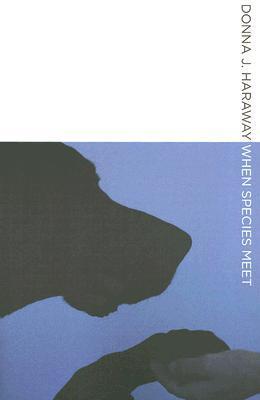
When Species Meet book cover
When Species Meet
2007
First Published
3.85
Average Rating
438
Number of Pages

In 2006, about 69 million U.S. households had pets, giving homes to around 73.9 million dogs, 90.5 million cats, and 16.6 million birds, and spending over $38 billion dollars on companion animals. As never before in history, our pets are truly members of the family. But the notion of “companion species”—knotted from human beings, animals and other organisms, landscapes, and technologies—includes much more than “companion animals.” In When Species Meet, Donna J. Haraway digs into this larger phenomenon to contemplate the interactions of humans with many kinds of critters, especially with those called domestic. At the heart of the book are her experiences in agility training with her dogs Cayenne and Roland, but Haraway’s vision here also encompasses wolves, chickens, cats, baboons, sheep, microorganisms, and whales wearing video cameras. From designer pets to lab animals to trained therapy dogs, she deftly explores philosophical, cultural, and biological aspects of animal-human encounters. In this deeply personal yet intellectually groundbreaking work, Haraway develops the idea of companion species, those who meet and break bread together but not without some indigestion. “A great deal is at stake in such meetings,” she writes, “and outcomes are not guaranteed. There is no assured happy or unhappy ending—socially, ecologically, orscientifically. There is only the chance for getting on together with some grace.” Ultimately, she finds that respect, curiosity, and knowledge spring from animal-human associations and work powerfully against ideas about human exceptionalism.
Avg Rating
3.85
Number of Ratings
604
5 STARS
29%
4 STARS
39%
3 STARS
22%
2 STARS
7%
1 STARS
3%
goodreads

Author

Donna Haraway
Donna Haraway
Author · 17 books

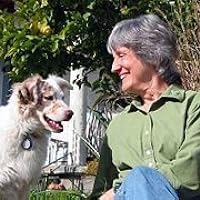
Donna J. Haraway is an American Professor Emerita in the History of Consciousness Department and Feminist Studies Department at the University of California, Santa Cruz, United States. She is a prominent scholar in the field of science and technology studies, described in the early 1990s as a "feminist, rather loosely a postmodernist". Haraway is the author of numerous foundational books and essays that bring together questions of science and feminism, such as "A Cyborg Manifesto: Science, Technology, and Socialist-Feminism in the Late Twentieth Century" (1985) and "Situated Knowledges: The Science Question in Feminism and the Privilege of Partial Perspective". Additionally, for her contributions to the intersection of information technology and feminist theory, Haraway is widely cited in works related to Human Computer Interaction (HCI). Her Situated Knowledges and Cyborg Manifesto publications in particular, have sparked discussion within the HCI community regarding framing the positionality from which research and systems are designed. She is also a leading scholar in contemporary ecofeminism, associated with post-humanism and new materialism movements. Her work criticizes anthropocentrism, emphasizes the self-organizing powers of nonhuman processes, and explores dissonant relations between those processes and cultural practices, rethinking sources of ethics. Haraway has taught Women's Studies and the History of Science at the University of Hawaii and Johns Hopkins University. Haraway's works have contributed to the study of both human-machine and human-animal relations. Her works have sparked debate in primatology, philosophy, and developmental biology. Haraway participated in a collaborative exchange with the feminist theorist Lynn Randolph from 1990 to 1996. Their engagement with specific ideas relating to feminism, technoscience, political consciousness, and other social issues, formed the images and narrative of Haraway's book Modest_Witness for which she received the Society for Social Studies of Science's (4S) Ludwik Fleck Prize in 1999. In 2000, Haraway was awarded the Society for Social Studies of Science's John Desmond Bernal Prize for her distinguished contributions to the field of science and technology studies. Haraway serves on the advisory board for numerous academic journals, including differences, Signs: Journal of Women in Culture and Society, Contemporary Women's Writing, and Environmental Humanities.

548 Market St PMB 65688, San Francisco California 94104-5401 USA
© 2026 Paratext Inc. All rights reserved