Margins
Margins
548 Market St PMB 65688, San Francisco California 94104-5401 USA
hello@margins.app
·
+1 (650) 223-5283
Privacy Policy
·
Terms of Use
© 2026 Paratext Inc. All rights reserved
Yale Historical Publications Series
Yale Historical Publications Series
Series · 2 books · 1988-1992
By
Jonathan D. Spence
,
Adam Jay Hirsch
Books in series
#2
Ts'ao Yin and the K'ang-Hsi Emperor
1988
. 1988 2nd print, bright clean copy, no markings, no dustjacket, Professional booksellers since 1981
#4
The Rise of the Penitentiary
1992
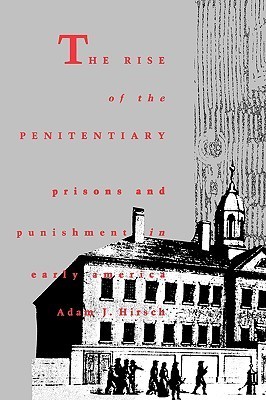
Before the nineteenth century, American prisons were used to hold people for trial and not to incarcerate them for wrong-doing. Only after independence did American states begin to reject such public punishment as whipping and pillorying and turn to imprisonment instead. In this legal, social, and political history, Adam J. Hirsch explores the reasons behind this change. Hirsch draws on evidence from throughout the early Republic and examines European sources to establish the American penitentiary's ideological origins and parallel development abroad. He focuses on Massachusetts as a case study of the transformation and presents in-depth data from that state. He challenges the notion that the penitentiary came as a by-product of Enlightenment thought, contending instead that the ideological foundations for criminal incarceration had been laid long before the eighteenth century and were premised upon old criminological theories. According to Hirsch, it was not new ideas but new social realities―the increasing urbanization and population mobility that promoted rampant crime―that made the penitentiary attractive to post-revolutionary legislators. Hirsch explores possible economic motives for incarcerating criminals and sentencing them to hard labor, but concludes that there is little evidence to support this. He finds that advocates of the penitentiary intended only that the prison pay for itself through enforced labor. Moreover, prison advocates frequently involved themselves in other contemporary social movements that reflected their concern to promote the welfare of criminals along with other oppressed groups. Kingsbury Memorial Fund
Authors
Jonathan D. Spence
Author · 16 books
Adam Jay Hirsch
Author · 1 book