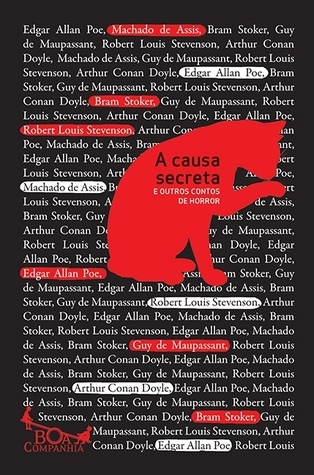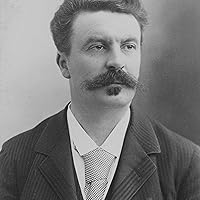



Seis mestres do suspense, entre eles, Edgar Allan Poe, Bram Stoker e Stevenson, estão reunidos nesta seleção de contos de horror, recheados de vingança, crueldade e morte. Os seis autores aqui reunidos representam o que há de mais importante na literatura dedicada ao gênero horror. Do precursor Edgar Allan Poe, que apresenta a atmosfera aristocrática das abadias do príncipe Próspero, personagem do conto “A máscara da morte rubra”, passando pela crueldade psicológica de Fortunato, de “A causa secreta”, de Machado de Assis, ou a morte surpreendente de Elias, um cientificista que sofre a vingança de um bicho no conto “A selvagem”, do irlandês Bram Stoker, autor da mais famosa história de vampiro na literatura, Drácula (1897). E ainda “A mão”, do francês Guy de Maupassant, “O rapa-carniça”, de Robert Louis Stevenson e “O cirurgião de Gaster Fell”, do também escocês Arthur Conan Doyle. Todas as histórias aproximam o leitor do obscuro e do indizível que muitas vezes só a literatura consegue traduzir.
Authors

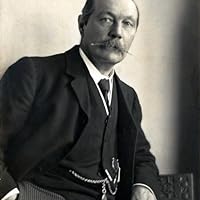
Sir Arthur Ignatius Conan Doyle was born the third of ten siblings on 22 May 1859 in Edinburgh, Scotland. His father, Charles Altamont Doyle, a talented illustrator, was born in England of Irish descent, and his mother, born Mary Foley, was Irish. They were married in 1855. Although he is now referred to as "Conan Doyle", the origin of this compound surname (if that is how he meant it to be understood) is uncertain. His baptism record in the registry of St Mary's Cathedral in Edinburgh gives 'Arthur Ignatius Conan' as his Christian name, and simply 'Doyle' as his surname. It also names Michael Conan as his godfather. At the age of nine Conan Doyle was sent to the Roman Catholic Jesuit preparatory school, Hodder Place, Stonyhurst. He then went on to Stonyhurst College, leaving in 1875. From 1876 to 1881 he studied medicine at the University of Edinburgh. This required that he provide periodic medical assistance in the towns of Aston (now a district of Birmingham) and Sheffield. While studying, Conan Doyle began writing short stories. His first published story appeared in "Chambers' Edinburgh Journal" before he was 20. Following his graduation, he was employed as a ship's doctor on the SS Mayumba during a voyage to the West African coast. He completed his doctorate on the subject of tabes dorsalis in 1885. In 1885 Conan Doyle married Louisa (or Louise) Hawkins, known as "Touie". She suffered from tuberculosis and died on 4 July 1906. The following year he married Jean Elizabeth Leckie, whom he had first met and fallen in love with in 1897. Due to his sense of loyalty he had maintained a purely platonic relationship with Jean while his first wife was alive. Jean died in London on 27 June 1940. Conan Doyle fathered five children. Two with his first wife—Mary Louise (28 January 1889 – 12 June 1976), and Arthur Alleyne Kingsley, known as Kingsley (15 November 1892 – 28 October 1918). With his second wife he had three children—Denis Percy Stewart (17 March 1909 – 9 March 1955), second husband in 1936 of Georgian Princess Nina Mdivani (circa 1910 – 19 February 1987; former sister-in-law of Barbara Hutton); Adrian Malcolm (19 November 1910–3 June 1970) and Jean Lena Annette (21 December 1912–18 November 1997). Conan Doyle was found clutching his chest in the hall of Windlesham, his house in Crowborough, East Sussex, on 7 July 1930. He had died of a heart attack at age 71. His last words were directed toward his wife: "You are wonderful." The epitaph on his gravestone in the churchyard at Minstead in the New Forest, Hampshire, reads: STEEL TRUE BLADE STRAIGHT ARTHUR CONAN DOYLE KNIGHT PATRIOT, PHYSICIAN & MAN OF LETTERS Conan Doyle's house, Undershaw, located in Hindhead, south of London, where he had lived for a decade, had been a hotel and restaurant between 1924 and 2004. It now stands empty while conservationists and Conan Doyle fans fight to preserve it. A statue honours Conan Doyle at Crowborough Cross in Crowborough, where Conan Doyle lived for 23 years. There is also a statue of Sherlock Holmes in Picardy Place, Edinburgh, close to the house where Conan Doyle was born. Series: * Sherlock Holmes


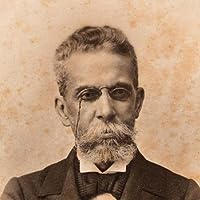
Joaquim Maria Machado de Assis, often known as Machado de Assis, Machado, or Bruxo do Cosme Velho, (June 21, 1839, Rio de Janeiro—September 29, 1908, Rio de Janeiro) was a Brazilian novelist, poet, playwright and short story writer. He is widely regarded as the most important writer of Brazilian literature. However, he did not gain widespread popularity outside Brazil in his own lifetime. Machado's works had a great influence on Brazilian literary schools of the late 19th century and 20th century. José Saramago, Carlos Fuentes, Susan Sontag and Harold Bloom are among his admirers and Bloom calls him "the supreme black literary artist to date."