Margins
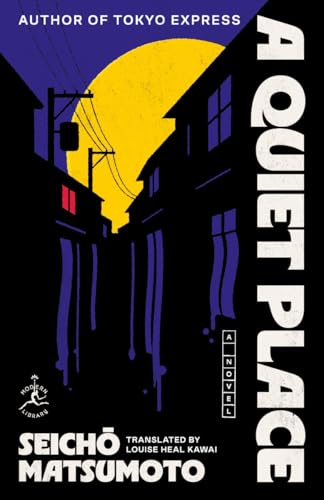
A Quiet Place book cover
A Quiet Place
2026
First Published
3.57
Average Rating
240
Number of Pages

An artfully twisty mystery about the psychological toll of jealousy and guilt from Seicho Matsumoto, who has been hailed as "Japan's Agatha Christie" ( The Sunday Times ) While on an important business trip, Tsuneo Asai receives word that his wife, Eiko, has died of a heart attack. She has suffered from heart problems in the past, so her death isn’t a complete shock, but she was tragically young to suffer such an end. Asai is rattled and sad but devotes himself fervently to his work as a government official to distract himself from the grief. It's not like his marriage was particularly passionate. But something about the circumstances of Eiko’s demise is bothering him. Her heart attack struck while she was walking, alone, along a residential Tokyo street where she had no particular connections or reasons to be. During a curious visit to the small shop on that street, where Eiko took her last breath, Asai notices a hotel at the top of the hill, one obviously meant as a clandestine meeting place for lovers. He begins to wonder if his soft-spoken, haiku-obsessed wife might have been leading a double life. As Asai's discoveries cause his mental state to rapidly unravel, and normalcy becomes more and more untenable for him, the fraught relationship between career and domesticity in Japan is laid bare.

Avg Rating
3.57
Number of Ratings
5,971
5 STARS
15%
4 STARS
39%
3 STARS
36%
2 STARS
9%
1 STARS
1%
goodreads

Author

Seicho Matsumoto
Seicho Matsumoto
Author · 25 books

Seicho Matsumoto (松本清張, Matsumoto Seichō), December 21, 1909 – August 4, 1992) was a Japanese writer. Matsumoto's works created a new tradition of Japanese crime fiction. Dispensing with formulaic plot devices such as puzzles, Matsumoto incorporated elements of human psychology and ordinary life into his crime fiction. In particular, his works often reflect a wider social context and postwar nihilism that expanded the scope and further darkened the atmosphere of the genre. His exposé of corruption among police officials as well as criminals was a new addition to the field. The subject of investigation was not just the crime but also the society in which the crime was committed. The self-educated Matsumoto did not see his first book in print until he was in his forties. He was a prolific author, he wrote until his death in 1992, producing in four decades more than 450 works. Matsumoto's mystery and detective fiction solidified his reputation as a writer at home and abroad. He wrote historical novels and nonfiction in addition to mystery/detective fiction. He was awarded the Akutagawa Prize in 1952 and the Kikuchi Kan Prize in 1970, as well as the Mystery Writers of Japan Award in 1957. He chaired the president of Mystery Writers of Japan from 1963 to 1971. Credited with popularizing the genre among readers in his country, Matsumoto became his nation's best-selling and highest earning author in the 1960s. His most acclaimed detective novels, including Ten to sen (1958; Points and Lines, 1970); Suna no utsuwa (1961; Inspector Imanishi Investigates, 1989) and Kiri no hata (1961; Pro Bono, 2012), have been translated into a number of languages, including English. He collaborated with film director Yoshitarō Nomura on adaptations of eight of his novels to film, including Castle of Sand.

548 Market St PMB 65688, San Francisco California 94104-5401 USA
© 2026 Paratext Inc. All rights reserved


