


Margins
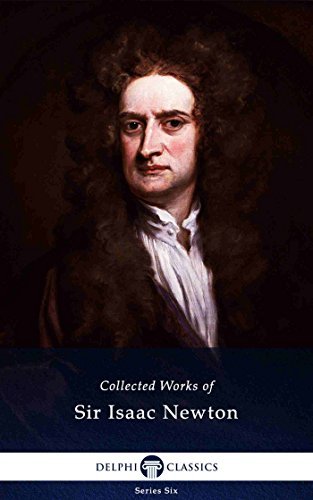
Collected Works of Sir Isaac Newton book cover
Collected Works of Sir Isaac Newton
2016
First Published
4.82
Average Rating
3136
Number of Pages

English physicist and mathematician, Sir Isaac Newton is widely regarded as one of the most influential scientists of all time. Newton’s book ‘Philosophiæ Naturalis Principia Mathematica’ laid the foundations for classical mechanics and ‘Optiks’ made seminal contributions to modern physical optics. This comprehensive eBook presents Newton’s collected works, with numerous illustrations, rare texts, informative introductions and the usual Delphi bonus material. (Version 1) * Beautifully illustrated with images relating to Newton’s life and works * New introductions, specially written for this collection, by Professor Kenneth Richard Seddon, OBE (QUILL, The Queen’s University of Belfast) * Images of how the books were first published, giving your eReader a taste of the original texts * Excellent formatting of the texts * Key works are fully illustrated with their original diagrams * Features three biographies - discover Newton’s intriguing life * Scholarly ordering of texts into chronological order and genres Please visit www.delphiclassics.com to browse through our range of exciting titles CONTENTS: Scientific Works PHILOSOPHIÆ NATURALIS PRINCIPIA MATHEMATICA THE MATHEMATICAL PRINCIPLES OF NATURAL PHILOSOPHY (MOTTE TRANSLATION) OPTICKS Theological Works THE CHRONOLOGY OF ANCIENT KINGDOMS AMENDED OBSERVATIONS ON DANIEL AND THE APOCALYPSE OF ST. JOHN AN HISTORICAL ACCOUNT OF TWO NOTABLE CORRUPTIONS OF SCRIPTURE The Biographies MEMOIRS OF SIR ISAAC NEWTON’S LIFE by William Stukeley SIR ISAAC NEWTON by Sarah K. Bolton SIR ISAAC NEWTON by Henry Martyn Taylor Please visit www.delphiclassics.com to browse through our range of exciting titles or to purchase this eBook as a Parts Edition of individual eBooks
Avg Rating
4.82
Number of Ratings
11
5 STARS
82%
4 STARS
18%
3 STARS
0%
2 STARS
0%
1 STARS
0%
goodreads

Author

Isaac Newton
Isaac Newton
Author · 16 books

Sir Isaac Newton, FRS, was an English physicist, mathematician, astronomer, natural philosopher, and alchemist. His Philosophiæ Naturalis Principia Mathematica, published in 1687, is considered to be the most influential book in the history of science. In this work, Newton described universal gravitation and the three laws of motion, laying the groundwork for classical mechanics, which dominated the scientific view of the physical universe for the next three centuries and is the basis for modern engineering. Newton showed that the motions of objects on Earth and of celestial bodies are governed by the same set of natural laws by demonstrating the consistency between Kepler's laws of planetary motion and his theory of gravitation, thus removing the last doubts about heliocentrism and advancing the scientific revolution. In mechanics, Newton enunciated the principles of conservation of momentum and angular momentum. In optics, he invented the reflecting telescope and developed a theory of colour based on the observation that a prism decomposes white light into a visible spectrum. He also formulated an empirical law of cooling and studied the speed of sound. In mathematics, Newton shares the credit with Gottfried Leibniz for the development of the differential and integral calculus. He also demonstrated the generalised binomial theorem, developed the so-called "Newton's method" for approximating the zeroes of a function, and contributed to the study of power series. Newton was also highly religious (though unorthodox), producing more work on Biblical hermeneutics than the natural science he is remembered for today. In a 2005 poll of the Royal Society asking who had the greater effect on the history of science, Newton was deemed much more influential than Albert Einstein.

548 Market St PMB 65688, San Francisco California 94104-5401 USA
© 2025 Paratext Inc. All rights reserved