Margins
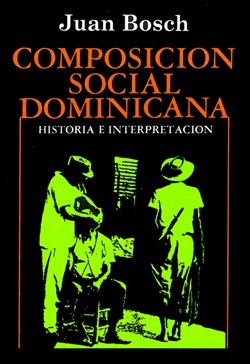
Composición social dominicana book cover
Composición social dominicana
1968
First Published
4.52
Average Rating
292
Number of Pages
Composicion social dominicana (Social Composition of the Dominican Republic), first published in 1970 in Spanish, and translated into English here for the first time, discusses the changing structure of social classes and groups in Dominican society from the first encounter between Europeans and Natives until the mid-twentieth century. This influential and pioneering book details the struggles of the Dominican people as they evolved from pre-colonial and colonial subjects to sovereign actors with the task of moving a republic forward, amidst imperialist desires and martial ambitions.Juan Bosch, one of the most well-known and best-loved Dominican politicians and scholars, here sets out the important themes that define modern Dominican society. He tackles topics such as the inter-imperialist rivalry between France, Spain, England, and Holland and its subsequent impact on the Caribbean region, as well as the U.S. occupation of the Dominican Republic from 1916-1924. He also discusses the aftermath of political alliances between liberals and conservatives during the birth of the Dominican Republic, the Restoration War fought against the Spanish Crown, the role of the petit bourgeoisie and the hateros (cattle-ranchers) in the formation of a Dominican oligarchy, the emergence of dictator Rafael Trujillo, and the composition of society during his time in power.This translation, introduced and contextualized by leading Dominican Studies scholar Wilfredo Lozano, opens up Bosch's work for a new generation of scholars studying the Caribbean.

Avg Rating
4.52
Number of Ratings
96
5 STARS
65%
4 STARS
27%
3 STARS
5%
2 STARS
2%
1 STARS
1%
goodreads

Author

Juan Bosch
Author · 18 books

Juan Bosch was born in the town of La Vega, Dominican Republic. His parents were Spanish Juan Bosch and Puerto Rican Angela Gaviño. He lived the first years of his childhood in a small rural community called Río Verde, where he began his primary studies; he attended high school in La Vega. In his youth he went to Santo Domingo and worked in commercial stores. Later he traveled to Spain, Venezuela and some of the Caribbean islands. He returned in 1931, and published his first short stories book, "Camino Real," the essay "Indios," and the short novel "La Mañosa," about the civil wars in the nineteenth century, which was acclaimed by critics. He created and edited the literary section in the newspaper Listín Diario, becoming a critic and essayist. In 1934 he married Isabel García and had two children with her: Leon and Carolina. As Trujillo's dictatorship was getting stronger and meaner, Bosch was jailed for his political ideas, being released after several months. In 1938, knowing that the tyrant wanted to buy him with a position in the Congress, Bosch managed to leave the country, settling in Puerto Rico. He was a politician, historian, short story writer, essayist, educator, and the first cleanly elected president of the Dominican Republic for a brief time in 1963. Previously, he had been the leader of the Dominican opposition in exile to the dictatorial regime of Rafael Trujillo for over 25 years. To this day he is remembered as an honest politician and regarded as one of the most prominent writers in Dominican literature. He is the founder of both the Dominican Revolutionary Party (PRD) in 1939 and the Dominican Liberation Party (PLD) in 1973. By 1939 Bosch had gone to Cuba, where he directed an edition of the completed works of Eugenio María de Hostos, something that defined his patriotic and humanist ideals. In July, with other Dominican expatriates, he founded the Partido Revolucionario Dominicano (PRD), which stood out as the most active front against Trujillo outside the Dominican Republic. Bosch heavily sympathised with leftist ideas, but he always denied any communist affiliation. He collaborated with the Cuban Revolutionary Party and had an important role in the making of the Constitution that was promulgated in 1940. Bosch married for the second time, this time a Cuban lady, Carmen Quidiello, with whom he had two more children, Patricio and Barbara. At the same time, his literary career was ascending, gaining important acknowledgments like the Hernandez Catá Prize in Havana for short stories written by a Latin American author. His works had a deep social content, among them "La Noche Buena de Encarnación Mendoza", "Luis Pié", "The Masters" and "The Indian Manuel Sicuri", all of them described by critics as masterpieces of the sort. Bosch was one of the main organizers of the 1949 military conspiracy that landed in Cayo Confites in the north coast of the Dominican Republic, to overthrow the dictatorship of Trujillo. However, the expedition failed, and Bosch fled to Venezuela, continuing his anti-Trujillo campaign. In Cuba, where he returned by requirement of his friends in the Authentic Revolutionary Party, he played a notorious part in the political life of Havana, being recognized as a promoter of social legislation and author of the speech pronounced by President Carlos Prío Socarrás when the body of José Martí was transferred to Santiago de Cuba. When Fulgencio Batista led a coup d'etat against Prío Socarrás and took over the presidency in 1952, Bosch was jailed by Batista's forces. After being liberated, he left Cuba and headed to Costa Rica, where he dedicated his time to pedagogical tasks, and to his activities as leader of the PRD. In 1959 the Cuban Revolution took place, led by Fidel Castro, causing a major political, economic and social upheaval in the Caribbean island. Bosch accurately perceived the process that had begun from those events, and wrote a letter to

548 Market St PMB 65688, San Francisco California 94104-5401 USA
© 2026 Paratext Inc. All rights reserved