1968
First Published
3.99
Average Rating
308
Number of Pages
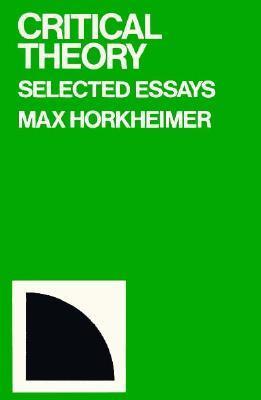
These essays, written in the 1930s and 1940s, represent a first selection in English from the major work of the founder of the famous Institute for Social Research in Frankfurt. Horkheimer's writings are essential to an understanding of the intellectual background of the New Left and the to much current social-philosophical thought, including the work of Herbert Marcuse. Apart from their historical significance and even from their scholarly eminence, these essays contain an immediate relevance only now becoming fully recognized.

Avg Rating
3.99
Number of Ratings
263
5 STARS
29%
4 STARS
48%
3 STARS
18%
2 STARS
3%
1 STARS
2%
goodreads
Author

Max Horkheimer
Author · 6 books
Max Horkheimer (1895–1973) was a leader of the so-called “Frankfurt School,” a group of philosophers and social scientists associated with the Institut für Sozialforschung (Institute of Social Research) in Frankfurt am Main. Horkheimer was the director of the Institute and Professor of Social Philosophy at the University of Frankfurt from 1930–1933, and again from 1949–1958. In between those periods he would lead the Institute in exile, primarily in America. As a philosopher he is best known (especially in the Anglophone world), for his work during the 1940s, including Dialectic of Enlightenment, which was co-authored with Theodor Adorno. While deservedly influential, Dialectic of Enlightenment (and other works from that period) should not be separated from the context of Horkheimer's work as a whole. Especially important in this regard are the writings from the 1930s, which were largely responsible for developing the epistemological and methodological orientation of Frankfurt School critical theory. This work both influenced his contemporaries (including Adorno and Herbert Marcuse) and has had an enduring influence on critical theory's later practitioners (including Jürgen Habermas, and the Institute's current director Axel Honneth).