Margins
Margins
548 Market St PMB 65688, San Francisco California 94104-5401 USA
hello@margins.app
·
+1 (650) 223-5283
Privacy Policy
·
Terms of Use
© 2026 Paratext Inc. All rights reserved
Das Kapital
Das Kapital
Series · 5 books · 1867-1894
By
Karl Marx
Books in series
#1a
Kapitał
1887
Capital
, one of Marx's major and most influential works, was the product of thirty years close study of the capitalist mode of production in England, the most advanced industrial society of his day. This new translation of
Volume One
, the only volume to be completed and edited by Marx himself, avoids some of the mistakes that have marred earlier versions and seeks to do justice to the literary qualities of the work. The introduction is by Ernest Mandel, author of
Late Capitalism
, one of the only comprehensive attempts to develop the theoretical legacy of Capital.
#1
Capital
1867
Capital, one of Marx's major and most influential works, was the product of thirty years close study of the capitalist mode of production in England, the most advanced industrial society of his day. This new translation of Volume One, the only volume to be completed and edited by Marx himself, avoids some of the mistakes that have marred earlier versions and seeks to do justice to the literary qualities of the work. The introduction is by Ernest Mandel, author of Late Capitalism, one of the only comprehensive attempts to develop the theoretical legacy of Capital.
#2
Capital
1885
The "forgotten" second volume of Capital, Marx's world-shaking analysis of economics, politics, and history, contains the vital discussion of commodity, the cornerstone to Marx's theories.
#3
Capital
1894
Capital, Vol 3, subtitled The Process of Capitalist Production as a Whole, was prepared by Friedrich Engels from notes left by Marx & published in 1894. It's in seven parts: 1.The conversion of Surplus Value into Profit & the rate of Surplus Value into the rate of Profit 2.Conversion of Profit into Average Profit 3.The Law of the Tendency of the Rate of Profit to Fall 4.Conversion of Commodity Capital & Money Capital into Commercial Capital & Money-Dealing (Merchant's) Capital 5.Division of Profit Into Interest & Profit of Enterprise, Interest Bearing Capital 6.Transformation of Surplus-Profit into Ground Rent 7.Revenues & Their Sources The work is best known today for part 3, which in summary says that as the organic fixed capital requirements of production rise as a result of advancements in production generally, the rate of profit tends to fall. This result, which orthodox Marxists believe is a principal contradictory characteristic leading to an inevitable collapse of the capitalist order, was held, as a result of various contradictions in the capitalist mode of production, result in crises whose resolution necessitates the emergence of an entirely new mode of production as the culmination of the same historical dialectic that led to the emergence of capitalism from prior forms.
#1-3
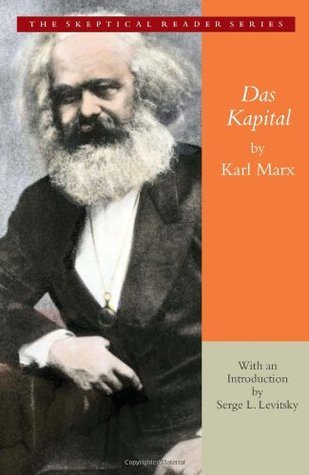
Das Kapital
1867
Das Kapital
, Karl Marx's seminal work, is the book that above all others formed the twentieth century. From
Kapital
sprung the economic and political systems that at one time dominated half the earth and for nearly a century kept the world on the brink of war. Even today, more than one billion Chinese citizens live under a regime that proclaims fealty to Marxist ideology. Yet this important tome has been passed over by many readers frustrated by Marx’s difficult style and his preoccupation with nineteenth-century events of little relevance to today's reader. Here Serge Levitsky presents a revised version of
Kapital
, abridged to emphasize the political and philosophical core of Marx’s work while trimming away much that is now unimportant. Pointing out Marx’s many erroneous predictions about the development of capitalism, Levitsky's introduction nevertheless argues for
Kapital's
relevance as a prime example of a philosophy of economic determinism that "subordinates the problems of human freedom and human dignity to the issues of who should own the means of production and how wealth should be distributed." Here then is a fresh and highly readable version of a work whose ideas provided inspiration for communist regimes' ideological war against capitalism, a struggle that helped to shape the world today.
Author
Karl Marx
Author · 174 books