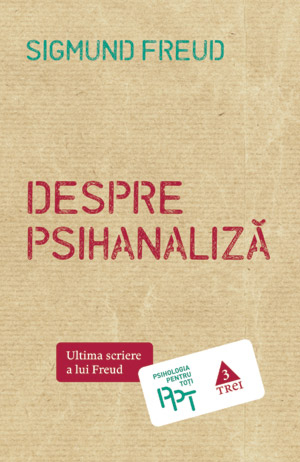



Prezentul volum este dedicat unei expuneri sintetice și accesibile a psihanalizei, care inglobează și depăseste primele Prelegeri de introducere în psihanaliză (1916—) și seria nouă a acelorași prelegeri din 1933. Cronologic, ea acoperă aproape treizeci de ani, din 1909, anul celor cinci conferințe ținute în Statele Unite, care au marcat intrarea triumfală a psihanalizei în Lumea Nouă, și 1938, ultimul an de viată al lui Freud, când începe această scriere, rămasă neterminată. Adresându-se, datorită conținutului său, în primul rând celor care doresc să se inițieze în psihanaliză —studenti ai facultătilor de psihologie, medicină, pedagogie, sociologie, filosofie, litere și teologie —, volumul de fată poate reține și atenția specialiștilor prin faptul că reprezintă o sinteză a întregii opere a lui Freud, la care se adaugă idei noi. Nu, conștiența nu poate fi esența elementului psihic, ea este numai o calitate a acestuia, și anume o calitate inconstantă care mai des este absentă, decât prezentă. Factorul psihic în sine, oricare i-ar fi natura, este inconștient, și probabil de un tip asemănător cu toate celelalte procese din natură despre care avem cunostintă. Pentru argumentarea acestei aserțiuni, psihanaliza se raportează la un număr de fapte. Freud Visul este o psihoză, cu toate inepțiile, formațiunile delirante, iluziile senzoriale ale unei psihoze. E adevărat, este o psihoză de scurtă durată, inofensivă, inzestrată chiar cu o funcție folositoare, initiată prin acordul persoanei, incheiată printr-un act de vointă de către ea. Cu toate acestea, este o psihoză și invătăm pe baza ei că pană și o modificare atât de profundă a vieții psihice poate fi anulată, poate lăsa spațiu funcției normale. Este atunci prea temerar să sperăm că ar trebui să putem supune și imbolnăvirile spontane temute ale vieții psihice influenței noastre și să le vindecăm? Freud
Author

Dr. Sigismund Freud (later changed to Sigmund) was a neurologist and the founder of psychoanalysis, who created an entirely new approach to the understanding of the human personality. He is regarded as one of the most influential—and controversial—minds of the 20th century. In 1873, Freud began to study medicine at the University of Vienna. After graduating, he worked at the Vienna General Hospital. He collaborated with Josef Breuer in treating hysteria by the recall of painful experiences under hypnosis. In 1885, Freud went to Paris as a student of the neurologist Jean Charcot. On his return to Vienna the following year, Freud set up in private practice, specialising in nervous and brain disorders. The same year he married Martha Bernays, with whom he had six children. Freud developed the theory that humans have an unconscious in which sexual and aggressive impulses are in perpetual conflict for supremacy with the defences against them. In 1897, he began an intensive analysis of himself. In 1900, his major work 'The Interpretation of Dreams' was published in which Freud analysed dreams in terms of unconscious desires and experiences. In 1902, Freud was appointed Professor of Neuropathology at the University of Vienna, a post he held until 1938. Although the medical establishment disagreed with many of his theories, a group of pupils and followers began to gather around Freud. In 1910, the International Psychoanalytic Association was founded with Carl Jung, a close associate of Freud's, as the president. Jung later broke with Freud and developed his own theories. After World War One, Freud spent less time in clinical observation and concentrated on the application of his theories to history, art, literature and anthropology. In 1923, he published 'The Ego and the Id', which suggested a new structural model of the mind, divided into the 'id, the 'ego' and the 'superego'. In 1933, the Nazis publicly burnt a number of Freud's books. In 1938, shortly after the Nazis annexed Austria, Freud left Vienna for London with his wife and daughter Anna. Freud had been diagnosed with cancer of the jaw in 1923, and underwent more than 30 operations. He died of cancer on 23 September 1939.