Margins
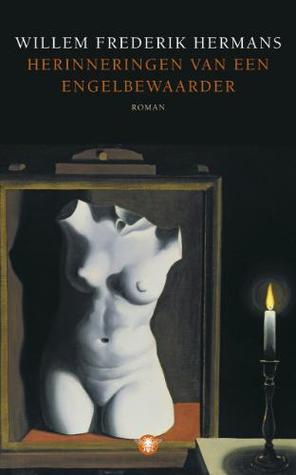
Herinneringen van een engelbewaarder book cover
Herinneringen van een engelbewaarder
1971
First Published
3.69
Average Rating
394
Number of Pages
Alberegt, a public prosecutor and self-proclaimed “man of minor failings,” speeds through Hook of Holland in his black Renault on May 9, 1940. His every move is guided by the cool and patient hand of a guardian angel. Flitting about from the hood of Alberegt’s car to the rim of his windswept hat, the angel attempts to quell their unhappy ward’s fears and secrets. (On occasion the heavenly narrator is so ashamed of Alberegt that they cover their own face with guardian wings.) The angel, musing for just a moment on the greater suffering of mankind, forgets a frenzied and lovelorn Alberegt at the wheel and Alberegt swerves into a small child crossing the road. This fatal event, on the eve of Nazi occupation of the Netherlands, spins the novel into a nightmare in which even expressions of empathy and humanity are edged out by cynicism and cruelty. Reminiscent of Georges Simenon, Albert Camus, and Kurt Vonnegut, A Guardian Angel Recalls is a brilliant and unnerving masterpiece.

Avg Rating
3.69
Number of Ratings
755
5 STARS
18%
4 STARS
43%
3 STARS
31%
2 STARS
6%
1 STARS
2%
goodreads

Author

Willem Frederik Hermans
Author · 26 books
Willem Frederik Hermans is one of the greatest post-war Dutch authors. Before devoting his entire life to writing, Hermans had been teaching Physical Geography at the University of Groningen for many years. He had already started writing and publishing in magazines at a young age. His polemic and provocative style led to a court case as early as 1952. His caustic pieces were compiled in Mandarijnen op zwavelzuur (Mandarines in Sulphuric Acid, 1963), which was reprinted with additions a number of times. It is Hermans’s belief that in order to survive people have to create their own reality. It is inevitable that all these experiences of reality will collide. Language is essential to create order out of chaos and plays an important role in this process. In his essays on Wittgenstein, Hermans studied this problem in depth. In his novels and stories Hermans places his characters in a world of certainty for themselves but equivocal for the reader. It is in this field of tension that the intrigue in De tranen der acacia’s (Acacia’s Tears, 1949) and in De donkere kamer van Damocles (The Darkroom of Damocles, 1958) develops. Although stories such as Moedwil en misverstand (Malice and Misunderstanding) and Paranoia have a surrealistic tendency, Hermans’ novels The Darkroom Of Damocles, Nooit meer slapen (Beyond Sleep), Uit talloos veel miljoenen (From Countless Millions) are more realistic or satirical and everything in his rich oeuvre is subordinate to the author’s pessimistic philosophy.
548 Market St PMB 65688, San Francisco California 94104-5401 USA
© 2026 Paratext Inc. All rights reserved