


Margins
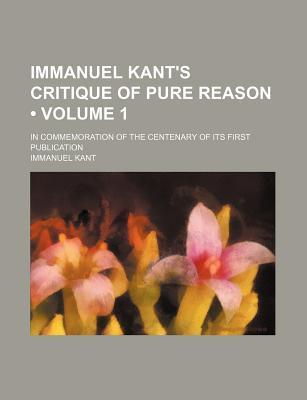
Immanuel Kant's Critique of Pure Reason Volume 1 book cover
Immanuel Kant's Critique of Pure Reason Volume 1
2010
First Published
4.00
Average Rating
576
Number of Pages

This work has been selected by scholars as being culturally important, and is part of the knowledge base of civilization as we know it. This work was reproduced from the original artifact, and remains as true to the original work as possible. Therefore, you will see the original copyright references, library stamps (as most of these works have been housed in our most important libraries around the world), and other notations in the work. This work is in the public domain in the United States of America, and possibly other nations. Within the United States, you may freely copy and distribute this work, as no entity (individual or corporate) has a copyright on the body of the work. As a reproduction of a historical artifact, this work may contain missing or blurred pages, poor pictures, errant marks, etc. Scholars believe, and we concur, that this work is important enough to be preserved, reproduced, and made generally available to the public. We appreciate your support of the preservation process, and thank you for being an important part of keeping this knowledge alive and relevant.
Avg Rating
4.00
Number of Ratings
6
5 STARS
50%
4 STARS
17%
3 STARS
17%
2 STARS
17%
1 STARS
0%
goodreads

Authors

Immanuel Kant
Immanuel Kant
Author · 69 books

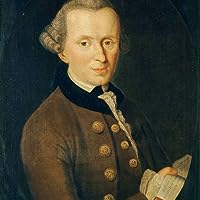
Immanuel Kant was an 18th-century philosopher from Königsberg, Prussia (now Kaliningrad, Russia). He's regarded as one of the most influential thinkers of modern Europe & of the late Enlightenment. His most important work is The Critique of Pure Reason, an investigation of reason itself. It encompasses an attack on traditional metaphysics & epistemology, & highlights his own contribution to these areas. Other main works of his maturity are The Critique of Practical Reason, which is about ethics, & The Critique of Judgment, about esthetics & teleology. Pursuing metaphysics involves asking questions about the ultimate nature of reality. Kant suggested that metaphysics can be reformed thru epistemology. He suggested that by understanding the sources & limits of human knowledge we can ask fruitful metaphysical questions. He asked if an object can be known to have certain properties prior to the experience of that object. He concluded that all objects that the mind can think about must conform to its manner of thought. Therefore if the mind can think only in terms of causality–which he concluded that it does–then we can know prior to experiencing them that all objects we experience must either be a cause or an effect. However, it follows from this that it's possible that there are objects of such a nature that the mind cannot think of them, & so the principle of causality, for instance, cannot be applied outside experience: hence we cannot know, for example, whether the world always existed or if it had a cause. So the grand questions of speculative metaphysics are off limits, but the sciences are firmly grounded in laws of the mind. Kant believed himself to be creating a compromise between the empiricists & the rationalists. The empiricists believed that knowledge is acquired thru experience alone, but the rationalists maintained that such knowledge is open to Cartesian doubt and that reason alone provides us with knowledge. Kant argues, however, that using reason without applying it to experience will only lead to illusions, while experience will be purely subjective without first being subsumed under pure reason. Kant’s thought was very influential in Germany during his lifetime, moving philosophy beyond the debate between the rationalists & empiricists. The philosophers Fichte, Schelling, Hegel and Schopenhauer saw themselves as correcting and expanding Kant's system, thus bringing about various forms of German Idealism. Kant continues to be a major influence on philosophy to this day, influencing both Analytic and Continental philosophy.

548 Market St PMB 65688, San Francisco California 94104-5401 USA
© 2025 Paratext Inc. All rights reserved