Margins
Sign in
Margins
548 Market St PMB 65688, San Francisco California 94104-5401 USA
hello@margins.app
·
+1 (650) 223-5283
Privacy Policy
·
Terms of Use
© 2026 Paratext Inc. All rights reserved
Joseph Campbell and Power of Myth
Joseph Campbell and Power of Myth
Series · 6 books · 1990-1992
By
Joseph Campbell
Books in series
#1
The Hero's Adventure
1992
Long before medieval knights charged off to slay dragons, tales of heroic adventures were an integral part of all world cultures. Campbell challenges everyone to see the presence of a heroic journey in his or her own life. "There is a typical hero sequence of actions which can be detected in stories from all over the world and from the many, many periods of history. It is essentially the one deed done by many, many different people. The hero or heroine is someone who has given his life to something bigger than himself or other than himself.... Losing yourself, giving yourself to another, that's a trial in itself, is it not? There is a big transformation of consciousness that's concerned. And what all the myths have to deal with is the transformation of consciousness—that you're thinking in this way, and you have now to think in that way." "Well, how is the consciousness transformed?" "By trials." "The tests that the hero undergoes?" "Tests or certain illuminating revelations. Trials and revelations are what it's all about."
#2
The Message of the Myth
1990
Campbell compares the creation story in Genesis with creation stories from around the world. Because the world changes, religion has to be transformed and new mythologies created. People today are stuck with old metaphors and myths that don't fit their needs. Moyers: " "The driving idea of his life was to understand the power of the stories and legends of the human race, especially those common themes and deep principles which energize our imaginations through the ages."" Campbell: " "Myths are clues to the spiritual potentialities of the human life.... Whenever one moves out of the transcendence, one comes into the field of opposites.... that is to say, I know the center and I know that good and evil are simply temporal apparitions.... With that fall in the Garden, nature was regarded as corrupt. There's a myth for you that corrupts the whole world for us and every spontaneous act is sinful."" Moyers: " "Your work in mythology has liberated my faith from the cultural prisons to which it has been sentenced."" Campbell: " "It has liberated my own. I know it's going to do it with everyone that gets the message.""
#3
The First Storytellers
1992
Campbell discusses the importance of accepting death as rebirth as in myth of the buffalo and the story of Christ, the rite of passage in primitive societies, the role of mystical Shamans, and the decline of ritual in today's society. Campbell: " "The ancient myths were designed to harmonize the mind and the body. The mind can ramble off in strange ways and want things that the body does not want. The myths and the rites were means of putting the mind in accord with the body and the way of life accord with the way nature dictates."" Moyers: " "So these old stories live in us?"" Campbell: " "They do indeed. The stages of human development are the same today as they were in the ancient times. As a child, you are brought up in a world of discipline, of obedience, and you are dependent on others. All this has to be transcended when you come to maturity, so that you can live not in dependency but with self-responsible authority.""
#4
Sacrifice and Bliss
1990
Campbell discusses the role of sacrifice in myth, which symbolizes the necessity for rebirth. He also talks about the significance of sacrifice—in particular, a mother's sacrifice for her child, and the sacrifice to the relationship in marriage—and stresses the need for every one of us to find our sacred place in the midst of today's fast-paced, technological world. Campbell: " "Going to your sacrifice as the winning stroke of your life was the essence of the early sacrificial idea... when you go to your death that way, as a god, you are going to eternal life, what's sad about that?... The realization of your bliss, your true being, comes when you have put aside what might be called passing moment with its terror and with its temptations and its statement of requirements of life that you should live this way.... I always tell my students to follow their bliss—where the deep sense of being is from, and where your body and soul want to go. When you have that feeling, then stay with it, and don't let anyone throw you off. I say don't be afraid to follow your bliss and doors will open where you didn't know they were going to be.""
#5
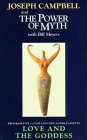
Love and the Goddess
1992
Campbell talks about romantic love, beginning with the 12th century troubadours, and addresses questions about the image of woman—as goddess, virgin, Mother Earth. Moyers: " "In the middle ages amour was celebrated by wandering minstrels who sang of what the eyes have made welcome to the heart. It helped create a distinctive Western consciousness that exalted the individual experience of men and woman over the authority and traditions of the church and state."" Campbell: " "Virgin birth is the birth of spiritual man out of animal man.... When you are awakened at the level of the heart to compassion and suffering with the other person, that is the beginning of humanity.... It is the suffering that evokes the humanity of the human heart. Love, you might say, is the burning point of life and since all is sorrowful, so is love. And the stronger the love, the more that pain"-"that love bears all things. Love itself is a pain, you might say"-"that is, the pain of being truly alive.""
#6
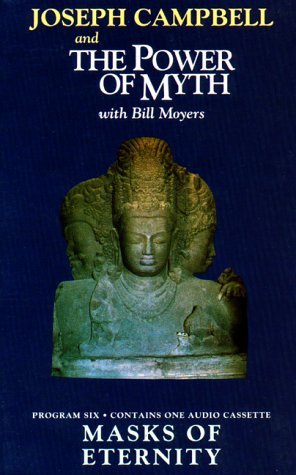
Masks of Eternity
1990
Campbell provides challenging insights into the concepts of God, religion and eternity, as revealed in Christian teachings and the beliefs of Buddhists, Navajo Indians, Schopenhauer, Jung and others. Moyers: " "The Images of God are many. Joseph Campbell called them the masks of eternity and said that they both cover and reveal the face of glory."" Campbell: " "A myth is a mask of god, a metaphor for what lies behind the visible world... the realization of wonder and also the experience of tremendous power which people living in the world of nature are experiencing all the time. The way in most Oriental thinking, and I think what we call primitive thinking, is that God is the manifestation of the energy—not the source."" Moyers: " "But is divinity just what we think?"" Campbell: " "Yes."" Moyers: " "What does that do to faith?"" Campbell: " "I don't have to have faith. I have experience.""
Author
Joseph Campbell
Author · 69 books