Margins
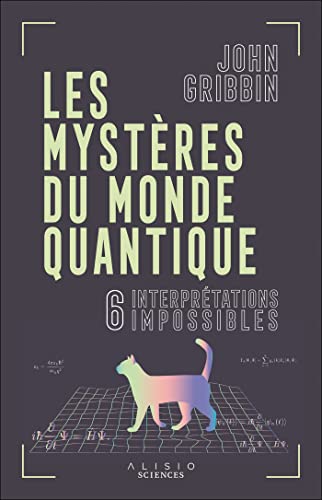
Les mystères du monde quantique book cover
Les mystères du monde quantique
6 interprétations impossibles
2021
First Published
2.67
Average Rating
176
Number of Pages
Fascinantes sont les règles du monde quantique. Elles nous disent qu'un chat peut être mort et vivant à la fois et qu'une particule peut se trouver à deux endroits en même temps. Depuis près d'un siècle, les meilleurs esprits se heurtent à ces mystères. Or, appliquée, la physique quantique est à l'origine de certaines des plus grandes avancées de la science : les lasers, le gps, bientôt l'ordinateur quantique à la puissance de calcul incomparable... Les scientifiques font donc face à ce dilemme ; continuer à effectuer des équations quantiques sans en chercher la signification ou tenter de déchiffrer la réalité qu'elles recouvrent. Par son talent de vulgarisateur, John Gribbin nous plonge dans le monde de l'infiniment petit à la découverte des six principales interprétations des grands physiciens qui ont relevé le défi de décoder la réalité quantique. Dans ce voyage au sein de la matière invisible, nous revivons les expériences d'Einstein, de Feynman, de Schrödinger... Leurs interprétations sont impossibles d'après le sens commun, et pourtant... Le monde n'existerait-il pas sauf quand nous le regardons ? Tout ce qui pourrait arriver est-il déjà arrivé et nous n'en aurions remarqué qu'une partie ? A vous à présent d'en décider.

Avg Rating
2.67
Number of Ratings
3
5 STARS
0%
4 STARS
33%
3 STARS
0%
2 STARS
67%
1 STARS
0%
goodreads

Author

John Gribbin
John Gribbin
Author · 80 books

John R. Gribbin is a British science writer, an astrophysicist, and a visiting fellow in astronomy at the University of Sussex. The topical range of his prolific writings includes quantum physics, biographies of famous scientists, human evolution, the origins of the universe, climate change and global warming. His also writes science fiction. John Gribbin graduated with his bachelor's degree in physics from the University of Sussex in 1966. Gribbin then earned his master of science (M.Sc.) degree in astronomy in 1967, also from the Univ. of Sussex, and he earned his Ph.D. in astrophysics from the University of Cambridge (1971). In 1968, Gribbin worked as one of Fred Hoyle's research students at the Institute of Theoretical Astronomy, and wrote a number of stories for New Scientist about the Institute's research and what were eventually discovered to be pulsars. In 1974, Gribbin published, along with Stephen Plagemann, a book titled The Jupiter Effect, that predicted that the alignment of the planets in quadrant on one side of the Sun on March 10, 1982 would cause gravitational effects that would trigger earthquakes in the San Andreas fault, possibly wiping out Los Angeles and its suburbs. Gribbin repudiated The Jupiter Effect in the July 17, 1980, issue of New Scientist magazine in which he stated that he had been "too clever by half". In 1984, Gribbin published In Search of Schrodinger's Cat: Quantum Physics and Reality, the book that he is best known for, which continues to sell well 28 years after publication. It has been described as among the best of the first wave of physics popularisations preceding Stephen Hawking's multi-million-selling A Brief History of Time. Gribbin's book has been cited as an example of how to revive an interest in the study of mathematics. In 2006, Gribbin took part in a BBC radio 4 broadcast as an "expert witness". Presenter Matthew Parris discussed with Professor Kathy Sykes and Gribbin whether Einstein "really was a 'crazy genius' ". At the 2009 World Conference of Science Journalists, the Association of British Science Writers presented Gribbin with their Lifetime Achievement award.

548 Market St PMB 65688, San Francisco California 94104-5401 USA
© 2026 Paratext Inc. All rights reserved