Margins




548 Market St PMB 65688, San Francisco California 94104-5401 USA
© 2026 Paratext Inc. All rights reserved
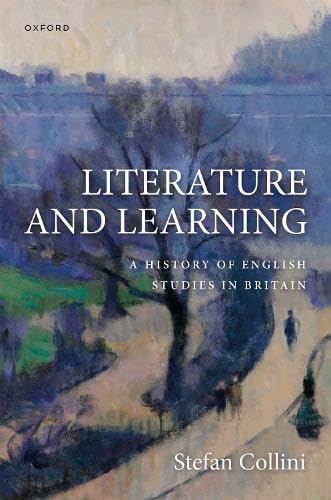
The study and teaching of English literature is generally regarded as one of the central disciplines in the modern university, yet for much of its history it struggled to gain academic legitimacy and was frequently derided as 'a soft option'. Its early professors responded by emphasizing its scholarly character, foregrounding philology and literary history in ways that marked the syllabus far into the twentieth century. Stefan Collini provides here the first full account of the discipline's development from its late-eighteenth-century beginnings up to the early 1960s. Paying special attention to institutional settings, he challenges numerous assumptions about the character of universities in the nineteenth and early twentieth centuries. From the detailed exploration of syllabuses, exam papers, and other institutional records, the impact of literary criticism is revealed to be later and more partial than is commonly assumed. Rather than seeing the early teaching of English literature as 'a substitute for religion' or 'a means to soften class conflict', Collini emphasizes the role of ideals of learnedness and scholarship, as well as of external factors such as opportunities for employment in the civil service and secondary school-teaching. There are full discussions of the parts played by such figures as John Churton Collins, A.C. Bradley, George Saintsbury, and Walter Raleigh, together with sceptical analyses of the decisive significance usually attributed to Matthew Arnold, T.S. Eliot, I.A. Richards, and F.R. Leavis. Separate chapters are devoted to neglected aspects of the story such as the role of Classics, the importance of the subject for women's higher education, and the connections with English teaching in schools. Drawing on extensive use of institutional archives and records as well as the writings of contemporary participants, the book offers a vivid and wide-ranging history of English-as-discipline and its centrality across academic, literary, cultural, and educational life over the past two year hundred years, as well as a resounding testament to its continued importance and relevance today.