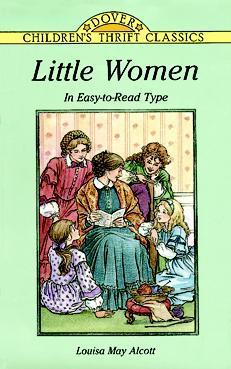
In this favorite story of long ago, you’ll meet the unforgettable March sisters—Meg, Jo, Beth, and Amy. They live with their mother, called Marmee, in a small house next to the Lawrence mansion. Their father is an army chaplain, away during the Civil War. You’ll enjoy getting to know the sisters and sharing the adventure of growing up. Meg is plump and earns money by caring for children in the neighborhood. Jo likes to write and make up stories and plays for her sisters. Beth is gentle and quiet and enjoys knitting by the fire and helping with household chores. Amy, the youngest, wants to be an artist. As you read or listen to this specially abridged version of the story, you’ll be there as the Marches share Christmas breakfast with a poor family; as Jo sells her beautiful long hair to buy a train ticket so Marmee can visit Mr. March; as Beth falls ill with scarlet fever; and as the sisters become grown women who fall in love and get married. Reprinted in large, easy-to-read type, this edition includes 30 illustrations that capture the joy and sadness of this wonderful story of a close-knit family in nineteenth-century America.
Author

People best know American writer Louisa May Alcott for Little Women (1868), her largely autobiographical novel. As A.M. Barnard: Behind a Mask, or a Woman's Power (1866) The Abbot's Ghost, or Maurice Treherne's Temptation (1867) A Long Fatal Love Chase (1866 – first published 1995) First published anonymously: A Modern Mephistopheles (1877) Philosopher-teacher Amos Bronson Alcott, educated his four daughters, Anna, Louisa, Elizabeth and May and Abigail May, wife of Amos, reared them on her practical Christianity. Louisa spent her childhood in Boston and Concord, Massachusetts, where visits to library of Ralph Waldo Emerson, excursions into nature with Henry David Thoreau, and theatricals in the barn at Hillside (now "Wayside") of Nathaniel Hawthorne enlightened her days. Like Jo March, her character in Little Women, young Louisa, a tomboy, claimed: "No boy could be my friend till I had beaten him in a race, ... and no girl if she refused to climb trees, leap fences...." Louisa wrote early with a passion. She and her sisters often acted out her melodramatic stories of her rich imagination for friends. Louisa preferred to play the "lurid" parts in these plays, "the villains, ghosts, bandits, and disdainful queens." At 15 years of age in 1847, the poverty that plagued her family troubled her, who vowed: "I will do something by and by. Don’t care what, teach, sew, act, write, anything to help the family; and I’ll be rich and famous and happy before I die, see if I won’t!" Confronting a society that offered little opportunity to women, seeking employment, Louisa determined "...I will make a battering-ram of my head and make my way through this rough and tumble world." Whether as a teacher, seamstress, governess, or household servant, Louisa ably found work for many years. Career of Louisa as an author began with poetry and short stories in popular magazines. In 1854, people published Flower Fables, her first book, at 22 years of age. From her post as a nurse in Washington, District of Columbia, during the Civil War, she wrote home letters that based Hospital Sketches (1863), a milestone along her literary path. Thomas Niles, a publisher in Boston, asked 35-year-old Louisa in 1867 to write "a book for girls." She wrote Little Women at Orchard House from May to July 1868. Louisa and her sisters came of age in the novel, set in New England during Civil War. From her own individuality, Jo March, the first such American juvenile heroine, acted as a living, breathing person rather than the idealized stereotype that then prevailed in fiction of children. Louisa published more than thirty books and collections of stories. Only two days after her father predeceased her, she died, and survivors buried her body in Sleepy Hollow cemetery in Concord.