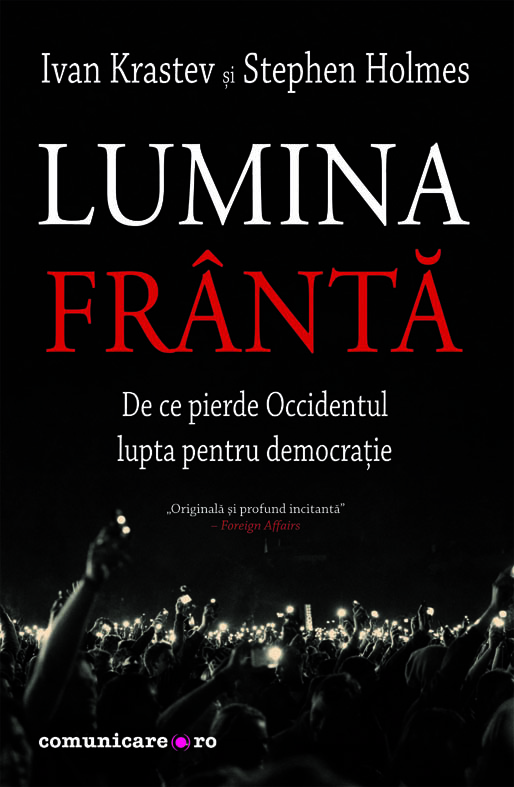



De ce, după ce a reuşit să câştige Războiul Rece, Occidentul pare să-şi fi pierdut echilibrul politic? De ce pierde acum terenul în lupta pentru democraţie şi liberalism? O carte de referinţă, semnată de doi eminenţi intelectuali, care investighează extraordinara istorie a ultimilor treizeci de ani şi ne transformă radical modul în care percepem şi înţelegem criza liberalismului. La începutul anilor ’90, speranţele ca democraţia liberală să se extindă spre Est erau foarte ridicate. Cu toate acestea, transformările din ţările Europei de Est au dus la o repudiere amară a liberalismului însuşi, prezentă nu numai în flancul estic al continentului, dar chiar şi în inima Occidentului. Scena geopolitică părea pregătită pentru o transformare „à la Pygmalion”, dar a sfârşit prin a fi confruntată cu o versiune „à la Frankenstein”. În acest sclipitor studiu de psihologie politică, Ivan Krastev şi Stephen Holmes demonstrează că presupusul sfârşit al istoriei s-a dovedit a fi de fapt începutul unei Epoci a Imitaţiei. Analizând istoria ultimilor treizeci de ani, ei demonstrează că forţa cea mai puternică din spatele valului de xenofobie populistă care a apărut în Europa de Est izvorăşte din resentimentele la adresa imperativului post-1989 ca aceste ţări să se occidentalizeze.

Authors
Stephen Holmes is Walter E. Meyer Professor of Law at New York University School of Law. Holmes' research centers on the history of European liberalism, the disappointments of democracy and economic liberalization after communism, and the difficulty of combating international Salafi terrorism within the bounds of the Constitution and the rule of law. In 1988, he was awarded a Guggenheim Fellowship to complete a study of the theoretical foundations of liberal democracy. He was a member of the Wissenschaftskolleg in Berlin during the 1991-92 academic year. He was named a Carnegie Scholar in 2003-2005 for his work on Russian legal reform. Besides numerous articles on the history of political thought, democratic and constitutional theory, state-building in post-communist Russia, and the war on terror, his publications include: Benjamin Constant and the Making of Modern Liberalism (1984); Anatomy of Antiliberalism (1993); Passions and Constraint: The Theory of Liberal Democracy (1995); The Cost of Rights, coauthored, with Cass Sunstein (1998); and Matador’s Cape: America’s Reckless Response to Terror (2007). After receiving his Ph.D. from Yale in 1976, Holmes (b. 1948) taught briefly at Yale and Wesleyan Universities before becoming a member of the Institute for Advanced Study in Princeton in 1978. He next moved to Harvard University's Department of Government, where he stayed until 1985, the year he joined the faculty at the University of Chicago where he taught, in both the Political Science Department and the Law School, until 1997. From 1997-2000, Holmes was Professor of Politics at Princeton University. In 2000, he moved to New York University School of Law where he is currently Walter E. Meyer Professor of Law and faculty co-director of the Center on Law and Security. At the University of Chicago, Holmes was Director of the Center for the Study of Constitutionalism in Eastern Europe. At Chicago and NYU he also served and as editor-in-chief of the East European Constitutional Review (1993-2003). In addition, he has also been the Director of the Soros Foundation program for promoting legal reform in Russia and Eastern Europe (1994-96).

Ivan Krastev (Bulgarian: Иван Кръстев, born 1965 in Lukovit, Bulgaria), is a political scientist, the chairman of the Centre for Liberal Strategies in Sofia, permanent fellow at the IWM (Institute of Human Sciences) in Vienna, and 2013-14-17 Richard von Weizsäcker fellow at the Robert Bosch Stiftung in Berlin. He is a founding board member of the European Council on Foreign Relations, a member of the board of trustees of the International Crisis Group and is a contributing opinion writer for The New York Times. From 2004 to 2006 Krastev was executive director of the International Commission on the Balkans chaired by the former Italian Prime Minister Giuliano Amato. He was Editor-in-Chief of the Bulgarian Edition of Foreign Policy and was a member of the Council of the International Institute for Strategic Studies, London (2005-2011). His books in English include "After Europe" (UPenn Press, 2017), "Democracy Disrupted. The Global Politics on Protest" (UPenn Press, May 2014), "In Mistrust We Trust: Can Democracy Survive When We Don't Trust Our Leaders", (TED Books, 2013); "The Anti-American Century", co-edited with Alan McPherson, (CEU Press, 2007) and "Shifting Obsessions: Three Essays on the Politics of Anticorruption" (CEU Press, 2004). He is a co-author with Stephen Holmes of a forthcoming book on Russian politics.