Margins




548 Market St PMB 65688, San Francisco California 94104-5401 USA
© 2026 Paratext Inc. All rights reserved
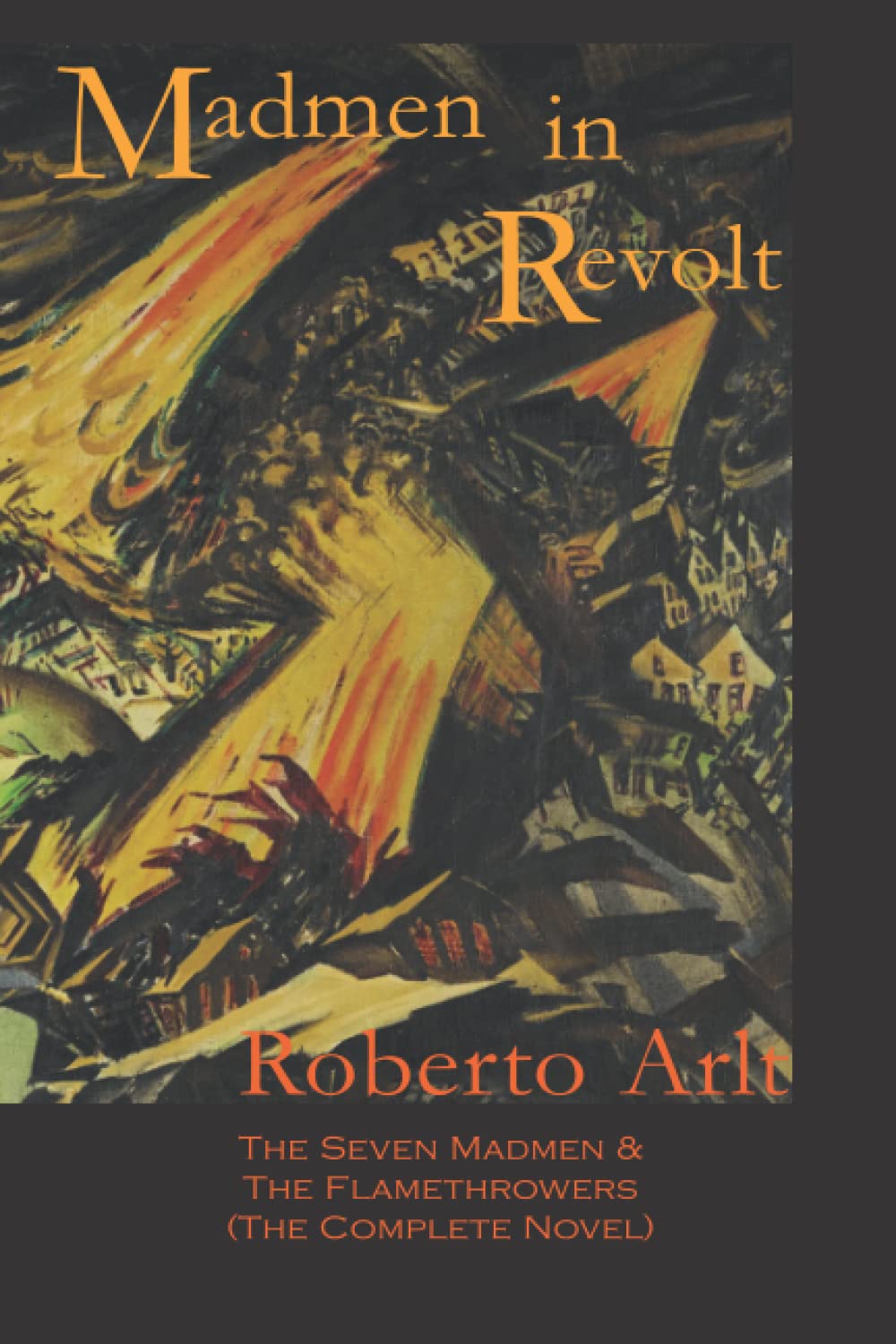
Madmen in Revolt contains Roberto Arlt’s complete masterpiece: The Seven Madmen & The Flamethrowers, combined in a single volume for the first time in history. The Seven Madmen is the first half this masterpiece and The Flamethrowers is its second half. The story begins with of a seminal group of madmen in 1920s Buenos Aires intent on blowing up the world. It is in fact about the end of humanity, of what it means to be human, and the central character in this Beckettian tragedy is Remo Erdosain, a man obsessed with technology, a man who is at war with a world controlled by corrupt elite who struggles with the idea of killing a single man. As the novel opens, Erdosain is accused of stealing 600 pesos He is willing to repay the money, but no one will lend him the money to do so. He does receive a check from a stranger named Haffner, but suddenly it seems that Erdosain lives in an alternate reality. In fact he has entered the world of the absurd as defined by Camus. Eventually, Erdosain meets The Astrologer, who instead of giving Erdosain money, convinces Erdosain that what the world needs is a new secret society devoted to revolution, and, what is even more astonishing, this new society needs Erdosain to participate in a plot to kidnap the thug Barust in order to extort money to finance its operations. One by one we are introduced to the seven madmen who will participate in this dream of a new world, but it soon becomes clear that the dream itself is a madness and that each of the madmen suffer from their own peculiar (absurdist) form of insanity. The Astrologer, for instance, is mostly intent on developing a series of bizarre inventions: weaponizing the Asiatic cholera bacillus, adapting steam engines to run by electromagnetics, and copperplating roses, to name three. By the end of the first book, the only thing the reader is certain of is that the story is not yet concluded. The Astrologer says: ““What we call madness is just new thoughts people aren’t used to ... Of course, there should only be a few like us...the big thing is for our actions to bring us vitality and energy. Yonder lies salvation.” We realize that the seven madmen have not yet found salvation. And Arlt himself says the novel will continue with a second book titled The Flamethrowers. In The Flamethrowers, the seven madmen try to bring their dream/nightmare vision of revolution to fruition, and the notion of anything resembling salvation disintegrates before our very eyes. Erdosain, caught between the desire for purity and the need to humiliate, murders his fourteen-old bride. The group’s plans to annihilate civilization become more technologically specific and more psychologically deranged. These our men isolated and marginalized by the external world. The inner realities each member of the group has created, realities characterized by games and fantasies, plots and conspiracies, have led to increased isolation from the world. The reader realizes we have entered the abyss, a place of technological terrors where our very sense of morality is abandoned. Towards the end of the novel, a jaundiced, fully uniformed (gasmasked!) soldier appears to Erdosain at night and they engage in a rather blasé conversation about gasses that reveals Erdosain’s belief in the efficacy of phosgene as a mass murdering agent. Their conversation, like the rest of the novel, underscores the horrible truth that the abyss we fear is at the very center of the human soul. We are provided a basic understanding of the aberrant behavior (the what but not truly the why), but there is no accompanying political or moral epiphany. What happens to the revolutionary vision of The Astrologer? What happens to Erdosain and the rest of the seven madmen? Perhaps it is best to say that the answer lies somewhere between fantasy and reality. (In other words, you’ll have to read the book to find out.)