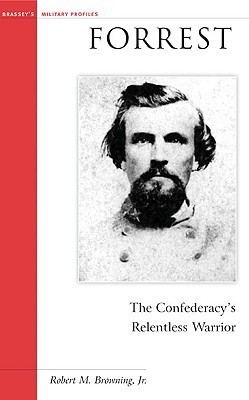
Revered by some, notorious to others, Nathan Bedford Forrest has long been considered one of the greatest soldiers of the American Civil War. Historian Robert Browning introduces readers to the facts and myths that surround this controversial man. Responsible for his family at a young age, Forrest scratched out a living on the frontier wilderness of Tennessee and Mississippi. He quickly developed traits—self-reliance, decisiveness, and assertiveness—that would later make him famous. Whether he was stalking a panther or challenging a gun-wielding assailant, Forrest realized that boldness was half the battle. In business the uneducated Forrest made a for-tune in various endeavors, including the slave trade. When the Civil War began, Forrest quickly became an adept recruiter and leader, despite his lack of training in military science. His cavalrymen became famous for the forced marches, deception, and audacious battlefield maneuvers they used to defeat forces that outnumbered them. Forrest also gained notoriety for his participation in the battle for Fort Pillow, Tennessee, in 1864. In a controversy that persists today, the high casualty rate among the Union’s African-American soldiers who surrendered there led to charges that Forrest’s men had perpetrated a racially motivated mas-sacre. After the war, Forrest became the first Grand Wizard of the Ku Klux Klan while also preaching the gospel of reconciliation between North and South amid the chaos of Reconstruction. This penetrating and succinct analysis provides an introduction to the life of Forrest and his place in American history.