


Margins
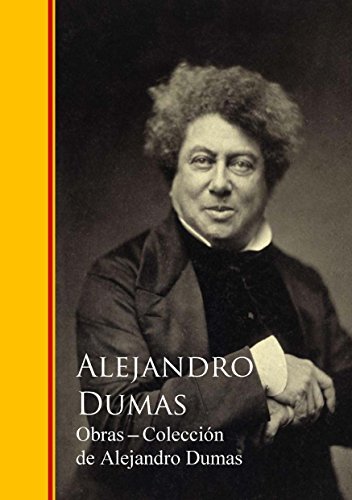
Obras - Colección de Alejandro Dumas book cover
Obras - Colección de Alejandro Dumas
Biblioteca de Grandes Escritores I
2015
First Published
4.36
Average Rating
5977
Number of Pages

Cómo san Eloy fue curado de la vanidad Deseo y posesión El biftec de oso El contrabandista a pesar suyo El hombre del alfanje El silbato encantado Historia de un muerto contada por él mismo La bofetada a Charlotte Corday La Dama Negra La dama pálida La peña del dragón La sirena del Rin La Tarasca Las tumbas de Saint-Denis Lo que es ignorar la lengua del país Los caballeros templarios Roldán después de Roncesvalles Un alma por nacer Un baile de máscaras La Casa del Viento Amaury Los tres mosqueteros El conde de Montecristo La Reina Margot El Tulipan negro La Dama de las Camelias El Hombre de la Máscara de Hierro TRES COMENSALES ADMIRADOS DE COMER JUNTOS —¡A PALACIO Y A ESCAPE! UN NEGOCIO ARREGLADO POR M. DE D'ARTAGNAN EN DONDE PORTHOS SE CONVENCE SIN HABER COMPRENDIDO LA SOCIEDAD DE BAISEMEAUX EL PRESO LA COLMENA, LAS ABEJAS Y LA MIEL OTRA CENA EN LA BASTILLA EL GENERAL DE LA ORDEN EL TENTADOR CORONA Y TIARA EL CASTILLO DE VAUX EL VINO DE MELÚN NÉCTAR Y AMBROSÍA LA HABITACIÓN DE MORFEO COLBERT CELOS LESA MAJESTAD UNA NOCHE EN LA BASTILLA LA SOMBRA DE FOUQUET LA MAÑANA EL AMIGO DEL REY CÓMO SE RESPETA LA CONSIGNA EN LA BASTILLA EL RECONOCIMIENTO DEL REY EL FALSO REY EN EL QUE PORTHOS CREE QUE CORRE TRAS UN DUCADO EL ÚLTIMO ADIÓS BEAUFORT PREPARATIVOS DE MARCHA INVENTARIO DE M. DE BEAUFORT LA FUENTE DE PLATA PRISIONERO Y CARCELEROS LAS PROMESAS ENTRE MUJERES LA CENA CONSEJOS DE AMIGO CÓMO EL REY LUIS XIV HIZO SU PEQUEÑO PAPEL EL CABALLO BLANCO Y EL CABALLO NEGRO EN EL CUAL LA ARDILLA CAE Y LA CULEBRA VUELA BELLE-ISLE-EN-MER LAS EXPLICACIONES DE ARAMIS LA DESPEDIDA DE PORTHOS EL HIJO DE BISCARRAT LA GRUTA DE LOCMARIA EN LA GRUTA UN CANTO DE HOMERO LA MUERTE DE UN TITÁN EL EPITAFIO DE PORTHOS EL REY LUIS XIV LOS AMIGOS DE M. FOUSUET EL TESTAMENTO DE PORTHOS ¡PADRE, PADRE! EL ANGEL DE LA MUERTE EL ÚLTIMO CANTO DEL POEMA EPÍLOGO LA MUERTE DE D'ARTAGNAN El tulipán negro Alexandre Dumas, fue un novelista y dramaturgo francés.
Avg Rating
4.36
Number of Ratings
55
5 STARS
62%
4 STARS
22%
3 STARS
11%
2 STARS
2%
1 STARS
4%
goodreads

Authors

Alexandre Dumas
Alexandre Dumas
Author · 308 books

This note regards Alexandre Dumas, père, the father of Alexandre Dumas, fils (son). For the son, see Alexandre Dumas fils. Alexandre Dumas, père (French for "father", akin to Senior in English), born Dumas Davy de la Pailleterie, was a French writer, best known for his numerous historical novels of high adventure which have made him one of the most widely read French authors in the world. Many of his novels, including The Count of Monte Cristo, The Three Musketeers, The Man in the Iron Mask, and The Vicomte de Bragelonne were serialized. Dumas also wrote plays and magazine articles, and was a prolific correspondent. Dumas was of Haitian descent and mixed-race. His father, General Thomas-Alexandre Dumas Davy de la Pailleterie, was born in the French colony of Saint-Domingue (present-day Haiti) to Alexandre Antoine Davy de la Pailleterie, a French nobleman, and Marie-Cessette Dumas, a black slave. At age 14 Thomas-Alexandre was taken by his father to France, where he was educated in a military academy and entered the military for what became an illustrious career. Dumas' father's aristocratic rank helped young Alexandre Dumas acquire work with Louis-Philippe, Duke of Orléans, then as a writer, finding early success. He became one of the leading authors of the French Romantic Movement, in Paris. Excerpted from Wikipedia.

Alexandre Dumas fils
Author · 5 books

Alexandre Dumas (fils) (son) was born in Paris, France, the illegitimate child of Marie-Laure-Catherine Labay (1794-1868), a dressmaker, and novelist Alexandre Dumas. During 1831 his father legally recognized him and ensured that the young Dumas received the best education possible at the Institution Goubaux and the Collège Bourbon. At that time, the law allowed the elder Dumas to take the child away from his mother. Her agony inspired Dumas fils to write about tragic female characters. In almost all of his writings, he emphasized the moral purpose of literature and in his play The Illegitimate Son (1858) he espoused the belief that if a man fathers an illegitimate child then he has an obligation to legitimize the child and marry the woman. Dumas' paternal great-grandparents were a French nobleman and a Haitian woman. In boarding schools, Dumas fils was constantly taunted by his classmates. These issues all profoundly influenced his thoughts, behaviour, and writing. During 1844 Dumas moved to Saint-Germain-en-Laye to live with his father. There, he met Marie Duplessis, a young courtesan who would be the inspiration for his romantic novel The Lady of the Camellias. Adapted into a play, it was titled in English (especially in the United States) as Camille and is the basis for Verdi's 1853 opera, La Traviata. Although he admitted that he had done the adaptation because he needed the money, he had a great success with the play. Thus began the career of Dumas fils as a dramatist, which was not only more renowned than that of his father during his lifetime but also dominated the serious French stage for most of the second half of the 19th century. After this, he virtually abandoned writing novels (though his semi-autobiographical L'Affaire Clemenceau (1867) achieved some success). On 31 December 1864, in Moscow, Dumas married Nadjeschda von Knorring (1826 – April 1895), daughter of Johan Reinhold von Knorring and wife, and widow of Alexander, Prince Naryschkine. The couple had two daughters: Marie-Alexandrine-Henriette Dumas, born 20 November 1860, who married Maurice Lippmann and was the mother of Serge Napoléon Lippmann (1886–1975) and Auguste Alexandre Lippmann (1881–1960); and Jeanine Dumas (3 May 1867–), who married Ernest d' Hauterive (1864–1957), son of George Lecourt d' Hauterive and wife (married in 1861) Léontine de Leusse. After Naryschkine's death, he married in June 1895 Henriette Régnier de La Brière (1851–1934), without issue. During 1874, he was admitted to the Académie française, and in 1894 he was awarded the Légion d'honneur. Alexandre Dumas fils died at Marly-le-Roi, Yvelines, on November 27, 1895 and was interred in the Cimetière de Montmartre in Paris. His grave is, perhaps coincidentally, only some 100 metres away from that of Marie Duplessis.

548 Market St PMB 65688, San Francisco California 94104-5401 USA
© 2026 Paratext Inc. All rights reserved